
Data Center Exterior Thermal Conditions Survey
A CFD Assessment of Mission-Critical Facilities
About the survey
This survey applies a single standardized exterior CFD methodology to several mission-critical facilities, using public-source inputs only. The intent is descriptive — to document how publicly attributed building designs behave under representative wind and emergency-operation conditions — rather than evaluative. Methodology, sources, and limitations are documented in full. Per-facility visualizations are available on request to the owner, developer, or design team of record for each facility.
Why owners and developers commission independent exterior validation
The exterior environment a data center rejects heat into — wind, plume, and heat-rejection recirculation across the whole site — is a distinct physics problem, and one an interior thermal model necessarily takes as a fixed boundary condition. As rack densities climb and campuses tighten, that exterior interaction is where avoidable risk concentrates. Across a build program, how thoroughly it gets scrutinized varies with whichever engineering partner holds the scope. An independent exterior check, run early — around 30% design, while the site layout is still fluid — is the cheapest point to catch a heat-rejection or generator-exhaust problem before it is built in. Resolved Analytics provides that check as the constant, working alongside the owner's design and engineering teams.
What's covered
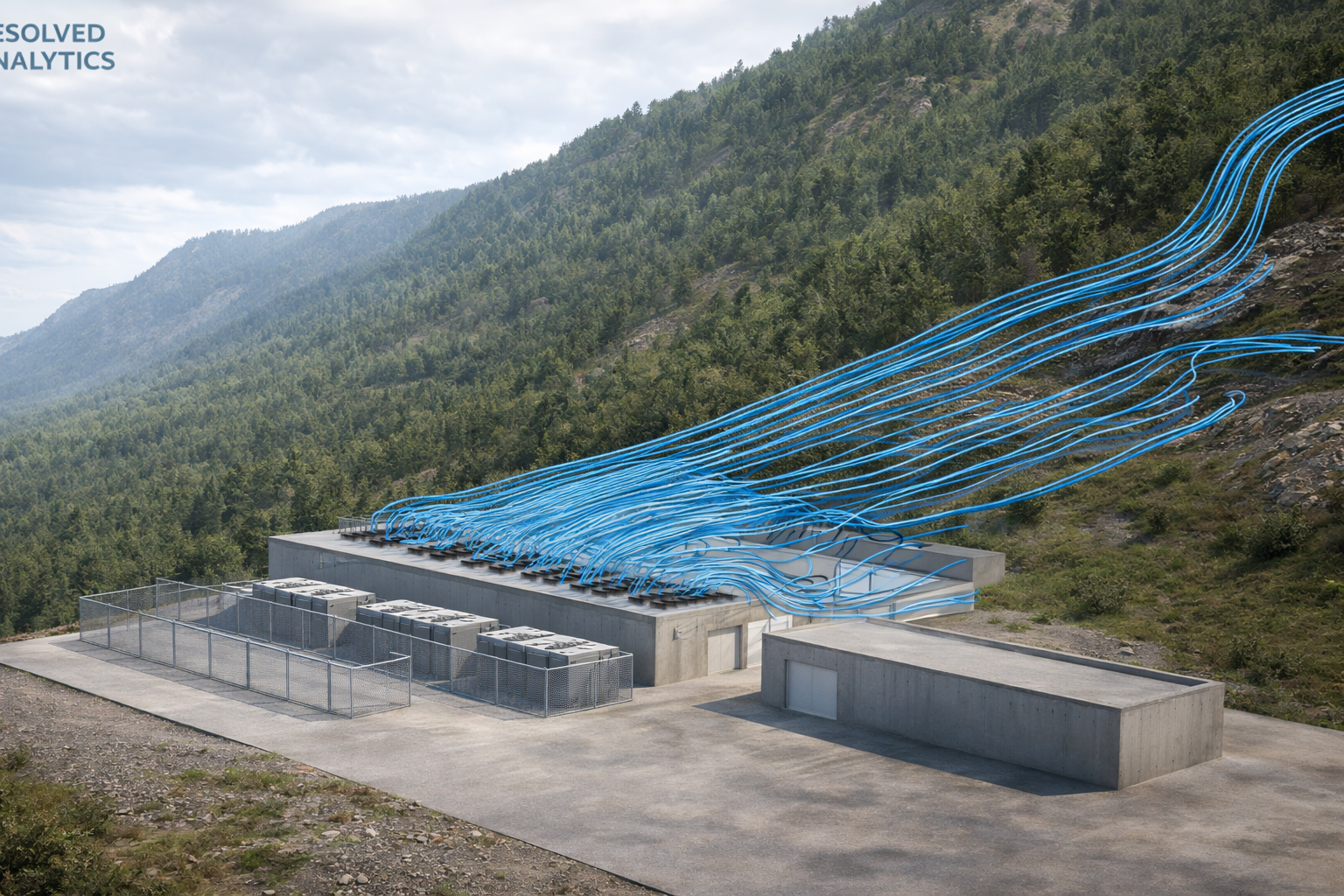
Each facility model resolves exterior airflow and thermal-plume behavior around the building: rooftop heat-rejection discharge, ground-level generator stack and radiator exhaust during emergency operation, and the resulting plume trajectories, recirculation patterns, and intake exposure. Interior thermal management, life-safety systems, and any aspect of as-built operational performance are out of scope.
Cohort
The initial cohort spans a range of U.S. climates, wind regimes, and cooling configurations — Northeastern, Mid-Atlantic, Southeastern, Midwestern, South Central, and Southwestern United States — chosen to exercise exterior-airflow behavior across ambient extremes and layout types rather than to concentrate on any single market. Subsequent cohorts will extend the survey to additional regions and facility types.
The studies
Seven screening-level studies, each applying the same standardized exterior methodology to a different real-world configuration. Public-source inputs only.
Frequently asked questions
- Who is this survey for?
- Primarily the owners, developers, and operators who carry a facility's exterior thermal risk, along with the design and engineering teams they work with. An independent, portfolio-level read of the exterior physics complements existing design work rather than duplicating it.
- Is this survey peer-reviewed?
- No. It is independent in-house research published for transparency, not a peer-reviewed publication. The methodology and limitations are documented in full so readers can evaluate the work on its merits.
- Who funded the survey?
- Resolved Analytics conducted the survey at its own expense as an internal research initiative. No client, building owner, or vendor funded any portion.
- How can I see a facility's results?
- The owner, developer, or design team of record for a facility can request its per-facility figures and a one-paragraph summary by contacting stewart@resolvedanalytics.com. We're also glad to screen a facility still in design.
- Will additional facilities be added?
- Yes. Subsequent cohorts will extend the survey to additional regions and facility types. New cohorts will be added as separate sections of this site.
Disclosure. This is independent research conducted by Resolved Analytics without engagement, sponsorship, or input from the named firms or building owners. All inputs are derived from cited public sources; no proprietary drawings, specifications, or operational data are used. Results represent idealized exterior conditions and do not represent the actual as-built performance of any facility. No claims are made regarding life-safety, code compliance, or operational performance. All firm and project names are used solely for purposes of identification and remain the property of their respective owners. This material is not engineering services rendered to any party.