
28 MW Data Center — Northeastern US
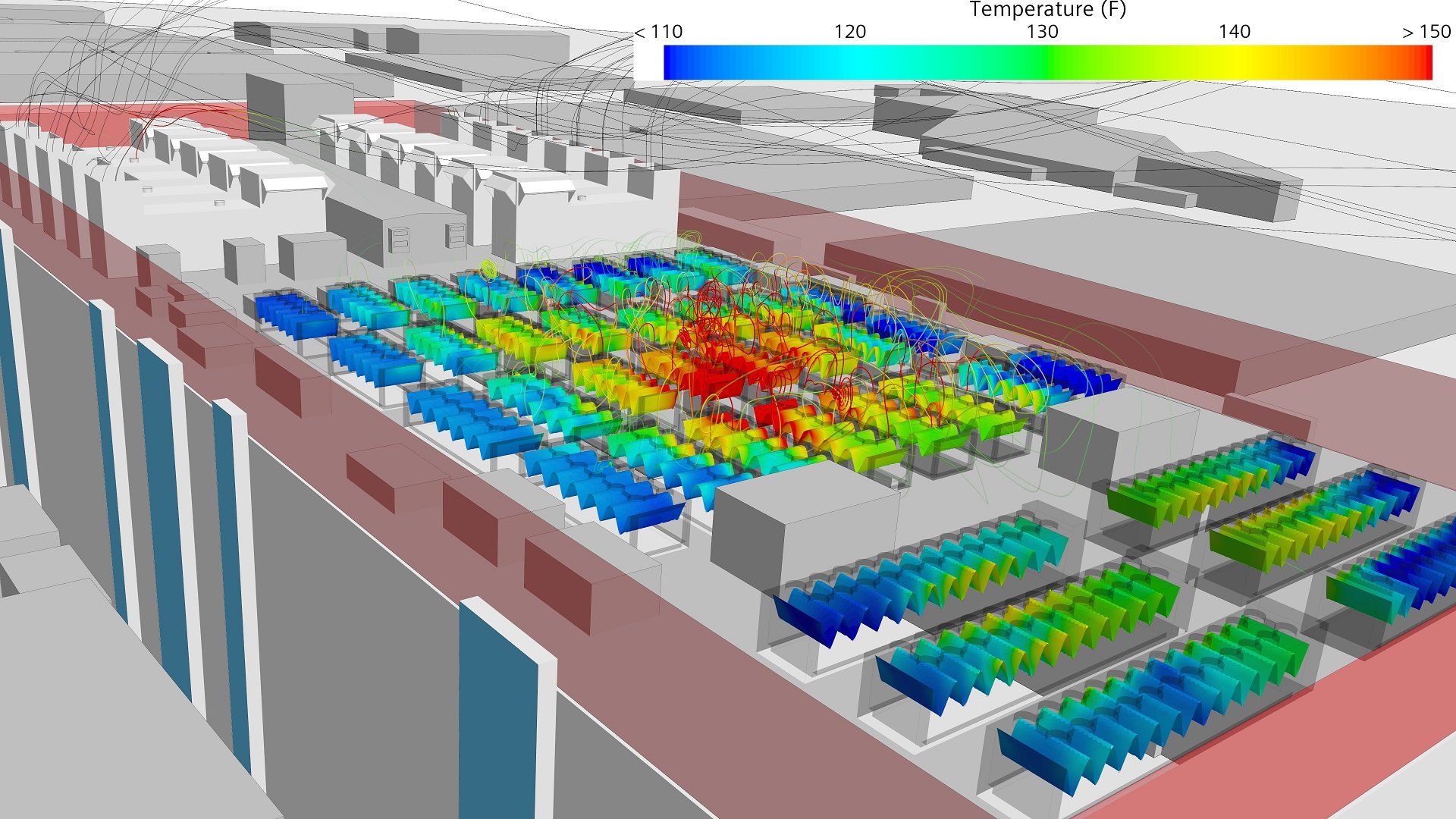
Rooftop chiller plume recirculation under a northwesterly wind: an upwind obstruction and the rooftop generator enclosures form a recirculation cell over the central chiller array. Public-source inputs. Screening-level.
What this page covers
This page presents a screening-level exterior CFD analysis of a 28 MW data center in the Northeastern United States, originally developed for a regional carrier-neutral provider and engineered by a national firm with a dedicated mission-critical practice. Both the heat-rejection plant and the standby generators sit on the roof: a rooftop air-cooled chiller array alongside diesel generator enclosures that stand taller than the adjacent chiller banks.
The result is a recirculation question. Under a northwesterly wind, the combination of a taller upwind structure and the rooftop generator enclosures produces a recirculation cell directly over the central chiller array — the kind of exterior interaction a standard four-point wind check can miss and an interior thermal model never sees.
Facility context
The facts below are derived entirely from cited public sources: published facility and provider materials, aerial and street-level imagery, and public terrain data. No proprietary drawings, specifications, or operational data are used. Identifying details are withheld; the facility is described by type and configuration only.
- Region.
- Northeast metropolitan market.
- Owner-operator.
- Originally developed for a regional carrier-neutral provider; subsequently part of a larger data-center platform. Not identified here.
- Engineer of record.
- A national engineering firm with a dedicated mission-critical practice. Not identified here.
- Critical IT capacity.
- 28 MW.
- Building.
- Two- to three-story shell, purpose-built, with heat-rejection equipment and standby generators carried on the roof.
- Cooling.
- Rooftop air-cooled chiller array with parallel V-coil banks.
- Backup power.
- Rooftop diesel generators in enclosures that stand taller than the adjacent chiller banks.
- Surroundings.
- Adjacent industrial structures to the northwest exceed the facility's roof height.
Scenario presented
- Wind and ambient.
- Operating scenario.
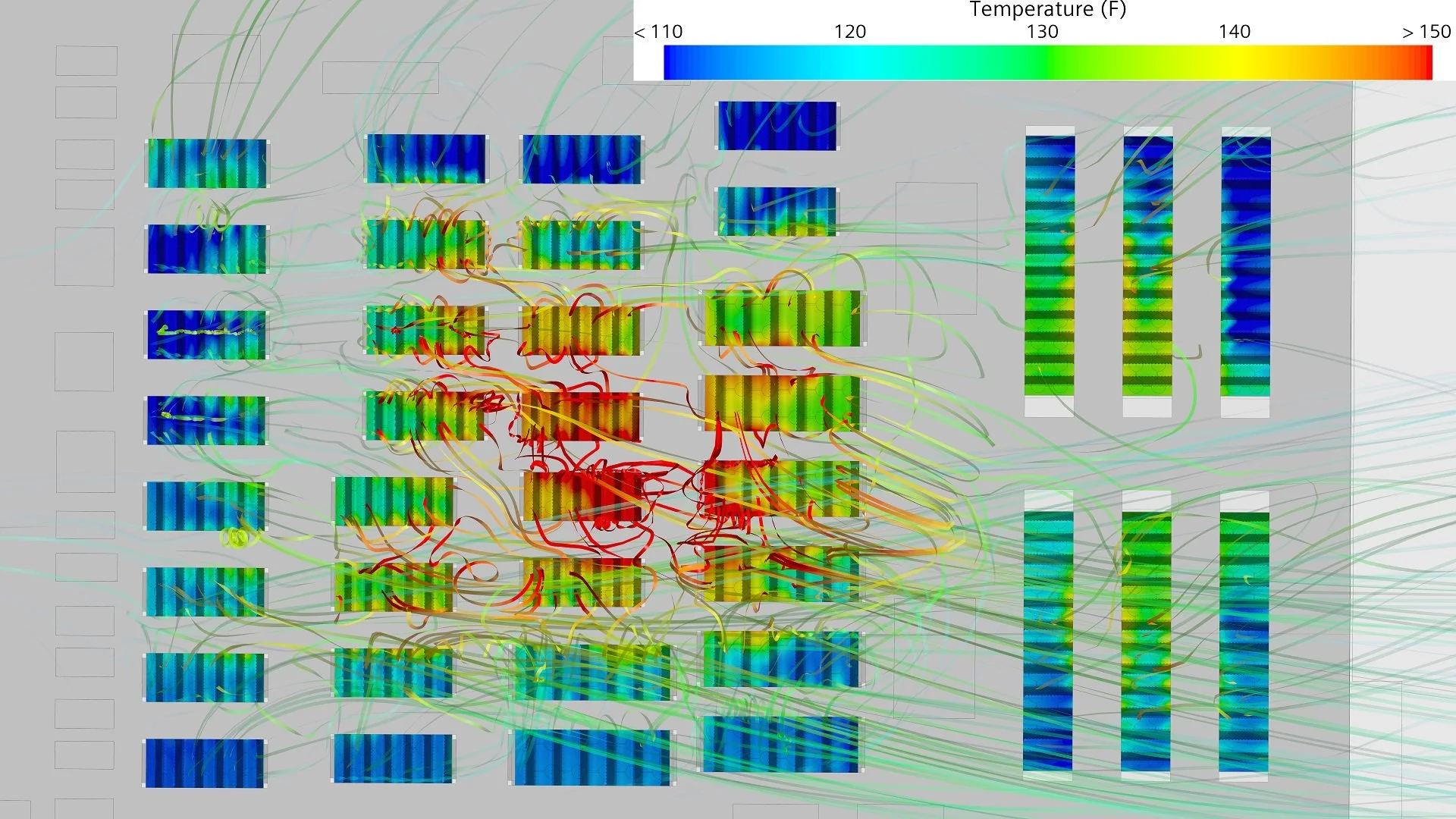
Wind from the northwest (315°) at 10 mph, 108°F ambient — a high-end summer design condition. Of the directions screened, this is the one that drives the recirculation cell onto the central chiller array.
N+R: all generators and all chillers running concurrently at full plant load — the on-generator condition that maximizes both the exhaust source and the heat-rejection demand together.
This case was isolated by a directional sweep across the full compass — not the standard four-point (N/S/E/W) check — which is the only way a specific vector like this one surfaces at all. The full wind-case matrix is available to the owner's team on request.
What the model shows
The observations below are qualitative readings of the presented scenario. Quantitative outputs — per-unit intake temperatures, recirculation magnitudes — are shared with the owner's team on request.
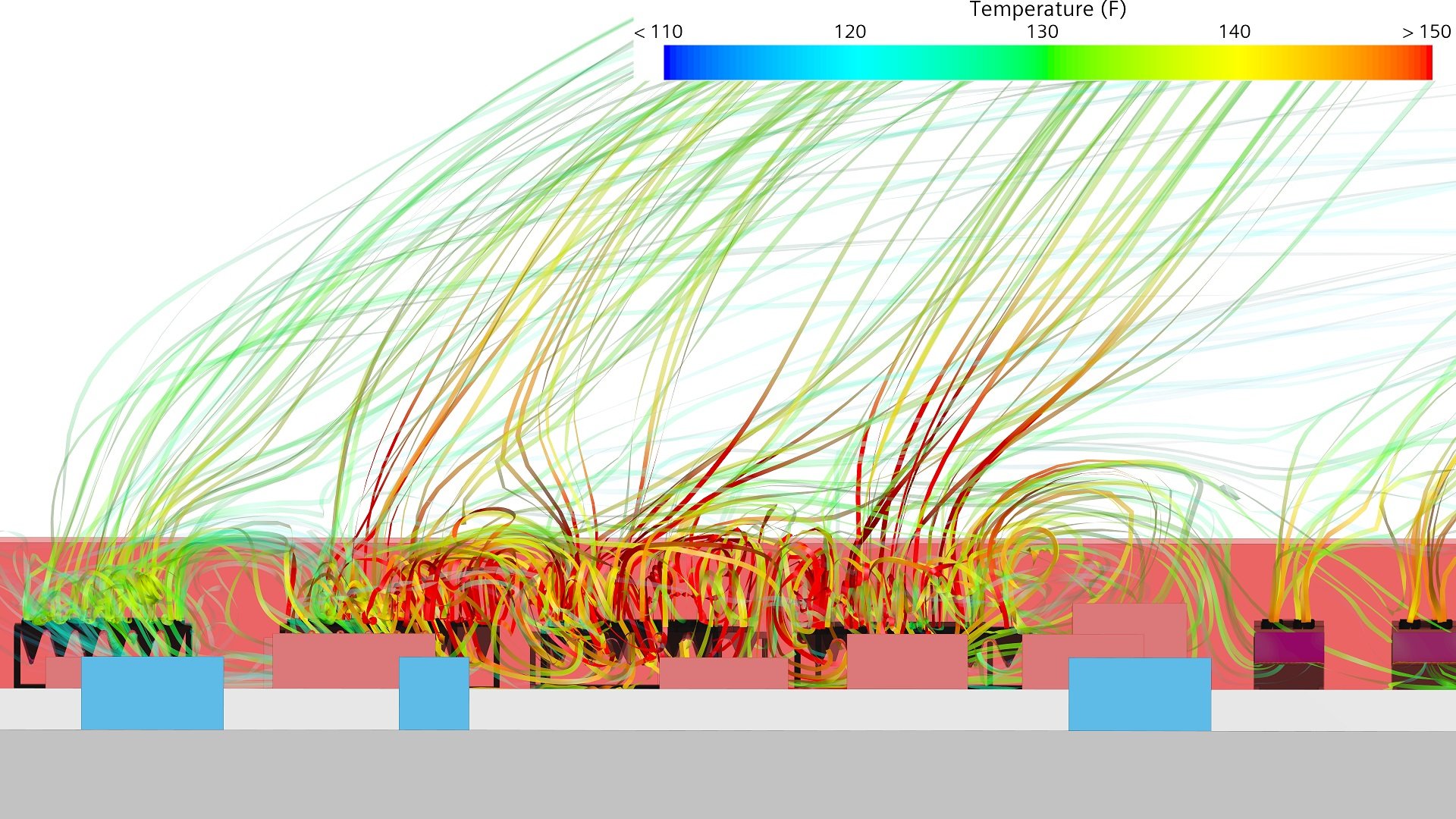
- An upwind obstruction forms a recirculation cell over the array. Taller upwind buildings and the rooftop generator enclosures combine to depress local airflow, forming a recirculation cell over the central portion of the chiller array rather than sweeping exhaust clear of it.
- Re-ingested exhaust approaches chiller shutdown thresholds. Within that cell, chiller exhaust re-enters neighboring units and can drive local intake temperatures above ~130°F — the regime where shutdown setpoints engage on many commercial air-cooled chiller platforms.
- Roof-on-roof geometry drives the exposure. With both generators and chillers on the roof, and the generator enclosures standing taller than the chiller banks, the recirculation question is decided by massing and adjacency — exactly the variables an exterior model resolves and an interior one takes as fixed.
- A question for the design team. An independent exterior model surfaces the one direction and location worth watching before it is built in, and frames the question worth putting to the engineering team on every project: were the adverse, non-standard wind vectors modeled explicitly, or only the standard design-day condition?
Methodology
The methodology applied here is the same standardized exterior CFD approach applied to every facility in the cohort — cylindrical far-field domain, logarithmic atmospheric boundary layer inlet, polyhedral mesh in Siemens STAR-CCM+, realizable k-ε RANS baseline. The presented case uses a 108°F ambient. Full domain setup, boundary conditions, solver choices, and stated limitations are documented at the Methodology page. Key terms are defined at the Key Terms and FAQ page.
Disclosure. This is independent research conducted by Resolved Analytics. All inputs are derived from cited public sources; no proprietary drawings, specifications, or operational data are used. The facility is described by type and configuration only and is not identified. Results represent idealized exterior conditions and do not represent the actual as-built performance of any facility. No claims are made regarding life-safety, code compliance, or operational performance. This material is not engineering services rendered to any party.