
Acoustiic: Saving Thousands of Dollars by Reducing Prototypes and Decreasing Iteration Time from Three Months to Two Weeks
Industry: Medical Devices and Pharmaceuticals
Product: Simcenter STAR-CCM+
Solution Partner: Resolved Analytics
Results:
Reduced iteration time from three months to two weeks
Saved thousands of dollars by reducing number of prototypes
Enabled greater creativity in exploring design options
Source: Siemens Digital Industries Software case study, © 2025 Siemens
Acoustiic Uses Simcenter STAR-CCM+ to Simulate and Manage Heat Generation in Compact, Complex Medical Devices

Flow Rate Change - Device Surface Temperature
Transforming Modern Medicine
Although medical treatment has advanced rapidly in the last century, invasive surgery poses risks and has long recovery times. Acoustiic is aiming to transform modern medicine with noninvasive ultrasound therapies that replace surgeries and drugs, making recovery much easier and faster. The company is developing software-controlled ultrasound devices that can be used to treat a wide range of conditions and medical ailments, including cancer and neurological conditions.
To ensure ease of use, the devices need to be as compact as possible. However, since they are full of electronics, this presents complex thermal challenges. Acoustiic turned to Siemens Digital Industries Software's Simcenter™ STAR-CCM+™ software, which is part of the Siemens Xcelerator business platform of software, hardware and services, to optimize heat management without increasing the size of the device or simplifying the electronics.
Leveraging a Collaborative Solution
Since this was Acoustiic's first foray into thermal simulation, the company launched an extensive product selection process to find the right software. Additionally, to help engineers get up to speed with thermal simulation, Acoustiic engaged with Resolved Analytics, a Siemens partner, during the product selection process.
"We wanted one package that would do everything we needed rather than having to use multiple solutions," says Paul Reynolds, founder and chief technology officer (CTO) at Acoustiic. "Having analyzed the available options on the market, Siemens had the right combination of software capabilities, cost and support offered by Resolved Analytics. Most importantly, we felt that during the discussions with various groups, this solution was more about solving a problem and not about extracting money from a customer."
"Speaking with Resolved Analytics gave us even more confidence that Simcenter STAR-CCM+ was the right product for us. Many alternatives are sales-centric rather than tech-centric, but we immediately felt that Resolved Analytics would work with us to help us achieve our goals rather than just sell us a product."

Cross Section of Velocity Vectors

Flow Streamlines Colored by Temperature
Iterating Rapidly
A dedicated engineer from Resolved Analytics worked closely with the Acoustiic team to set up the simulations and help develop their own capabilities for future projects.
“We began with an initial design concept, which Resolved Analytics helped us model,” says Dustin Dickens, the vice president (VP) of systems at Acoustiic. “We had ideas to improve performance and make the device more manufacturable, but this involved some radical design changes rather than minor iterations, so simulation was vital to exploring them.”
Building models within Simcenter STAR-CCM+ allowed engineers to simulate performance with various designs and understand the best way to remove heat from the device to ensure optimum performance.
“We carried out testing with physical models on our test benches for final validation, but not before we were confident in the functionality, thanks to virtual prototyping with Simcenter” says Dickens. “We went through five major designs before building a physical prototype. Without Simcenter STAR-CCM+, each design iteration would have taken two or three months and several thousand dollars to build and test. Using simulation was much cheaper and took only one or two weeks to run.”
Simulation was also crucial for adapting designs when subcomponents needed to be changed. “As the device was improved, the acoustics, mechanics and electronics were updated; thus, the thermal design had to change too,” says Reynolds. “The ultrasound capability is the top priority, as this is what delivers the benefit to the patient, so the thermal management must accommodate this. Simulation allowed us to rapidly iterate and be much more dynamic in our overall system design.”
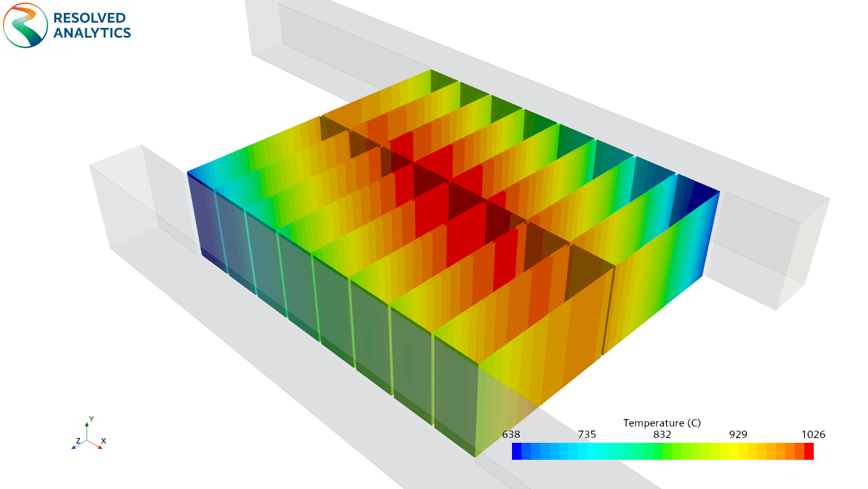
Surface Temperature CFD Results
Pushing Boundaries
Using Simcenter enabled Acoustiic to not only save time and money, but also push the boundaries of design experimentation.
"Leveraging Simcenter STAR-CCM+ allowed us to try some ideas, particularly with various interfaces within the device, that might seem a little crazy," says Dickens. "We would never have tried these with physical models because it would be too time-consuming and costly. Simulations let us be more creative, as it's just a matter of a few hours of modeling rather than weeks of building and testing. This led to some great results that we would never have achieved otherwise."
Creating Smaller Devices and Broader Treatments
Releasing the company's revolutionary devices is only the beginning for Acoustiic. Although it will have an immediate impact on improving healthcare, the company is already planning to introduce more products.
"This initial product is just the first of many, as we tackle multiple health conditions, including otherwise hard-to-treat neurological conditions such as depression, anxiety and drug use disorder," says Reynolds. "We will also be focusing on making the devices even smaller to make them more comfortable for users. Using Simcenter STAR-CCM+ will continue to be crucial to development as the devices become more complex and the thermal management challenges increase."

Baseline Result Velocity Vectors
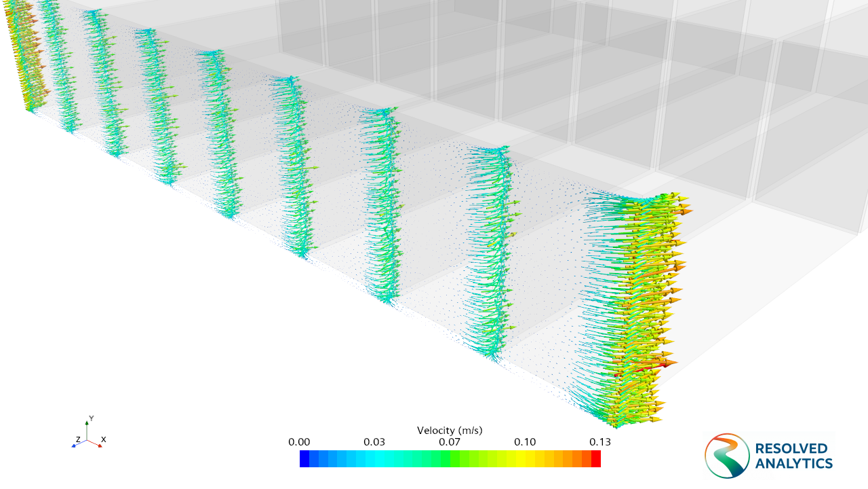
Alternate Case Velocity Vectors