
Simcenter STAR-CCM+ 2606: What's New in the Latest CFD Software Update?

A Complete Highlights Summary of New Features and Enhancements in Simcenter STAR-CCM+ Version 2606
Simcenter STAR-CCM+ 2606 was released on July 1, 2026, as part of Siemens' three-release-per-year cadence for the Simcenter product line. This release follows 2602 (February 2026) and precedes 2612 (December 2026). Siemens reports that over 550 new features were delivered across the 2025–2026 development cycle. The 2606 release is organized around the same four themes that have defined recent STAR-CCM+ development: Model the Complexity, Explore the Possibilities, Go Faster, and Stay Integrated.
This post covers all major new features and enhancements in 2606, organized by category and intended as a factual reference for engineers evaluating the update.
TLDR: Simcenter STAR-CCM+ 2606 (released July 1, 2026) is primarily a GPU acceleration release. For the first time, GPU-native solvers cover Eulerian Multiphase, Lagrangian Multiphase, Fluid Film, Dispersed Multiphase, mesh-based DEM, Complex Chemistry, Eddy Break Up, and Virtual Body simulations. Benchmarks range from 1.5x to 17x speedup versus CPU clusters depending on the application. Other headline additions include a new Finite Element Magnetic Field solver (10x faster for e-motor simulation), SPH conjugate heat transfer and aerodynamic forcing, a native acoustics Frequency Solver, Comparative Data Analysis across solution histories, Mixed Reality and hand-tracking for the Web Viewer, and a distributed memory parallel Surface Remesher. The unified server/client runtime introduced in 2602 is now the default. New workstation GPU support covers the NVIDIA RTX PRO 6000 Blackwell and AMD Radeon AI PRO R9700.
All feature information sourced from the official Simcenter STAR-CCM+ 2606 release documentation published by Siemens Digital Industries Software. You can read the What’s new in Simcenter STAR-CCM+ 2606? blog post here.
Table of Contents:
High-Performance Computing and GPU Acceleration
GPU-Native Phasic Porous Media Models
GPU-Native Support for Fluid Film and Dispersed Multiphase (DMP)
GPU-Native Support for Eulerian Multiphase (EMP)
GPU-Native Lagrangian Multiphase – Phase 1
GPU-Native Mesh-Based DEM
GPU-Native Complex Chemistry
GPU-Native Eddy Break Up (EBU)
GPU-Accelerated Virtual Body Simulations
GPU-Native Support for MMP Multicomponent Evaporation/Condensation (Spalding)
GPU-Native Support for VOF Flash Boiling (HRM)
GPU Support for Trajectory Motion
Multi-GPU Support for Simcenter STAR-CCM+ PhysicsAI
New GPU Hardware Support (NVIDIA RTX PRO 6000 Blackwell, AMD Radeon AI PRO R9700)
Better Multi-User Support on Multi-GPU Systems
Improved GPU Sparse Matrix Behavior for Coupled Flow Solver
Energy Consumption Monitoring and Reporting
Platform: Runtime, Deployment, and Interoperability
New Unified Server/Client Runtime
Enhanced System Diagnostic Utility ("detect")
Operating System Updates
MPI Updates
Teamcenter Integration
Co-Simulation Enhancements
Design Manager and PhysicsAI
Multi-GPU Support for PhysicsAI
Kendall Tau Metric for Derived Reports
Relaxed Parameter Requirement for .sim File Import
Data Analysis and Visualization
Comparative Data Analysis Using Mapped Field Functions and Solution Histories
Studio Scene: Export to Universal Scene Description (.usdz)
Studio Scene: Environments and Deep Learning Super Sampling (DLSS)
Simcenter Viewer (Web Viewer-Based Desktop Application)
Mixed Reality and Hand-Tracking for Web Viewer
Additional Data Analysis Enhancements
Geometry and Meshing
CAD Interoperability
3D-CAD Enhancements
Parts and Meshing Pipeline
Surface and Volume Meshing
Motion, Overset, and Adaptive Mesh Refinement
Physics
Fluid Flow
Heat Transfer
Eulerian Multiphase (EMP)
Smoothed-Particle Hydrodynamics (SPH)
Lagrangian Multiphase (LMP)
Discrete Element Method (DEM)
Reacting Flows
Electrochemistry
Structure Mechanics
Electromagnetics
Strategic Applications
Acoustics
E-Powertrain (Battery and Thermal Runaway)
In-Cylinder
Turbomachinery
User Guide and Tutorials
High-Performance Computing and GPU Acceleration
GPU acceleration remains the most heavily invested area of this release. Multiple new physics models receive GPU-native support for the first time in 2606.
GPU-Native Phasic Porous Media Models
GPU-native support has been added for phasic porous media models, targeting component simulations such as heat exchangers and catalytic converters used in vehicle thermal management. Benchmarks show a 3.5x speedup for a 4-million-cell fin-and-tube heat exchanger case, comparing 40 CPU cores to a single NVIDIA A100 GPU. CPU-equivalent solutions are maintained by sharing a unified code base between CPU and GPU implementations.
GPU-Native Support for Fluid Film and Dispersed Multiphase (DMP)
GPU-native solvers now cover Fluid Film and Dispersed Multiphase (DMP) simulations, including hybrid VOF-Film resolved film, DMP impingement and stripping to and from Fluid Film, Fluid Film surface tension, Fluid Film evaporation/condensation/boiling, and DMP droplet condensation. Benchmarks for a vehicle water management case show that a single GPU provides the equivalent of 273 CPU cores, consuming 18% of the energy of the CPU reference case.
GPU-Native Support for Eulerian Multiphase (EMP)
Eulerian Multiphase simulations now run natively on GPU, covering granular flows, suspensions and emulsions, energy, and turbulence models. Target applications include mixing tanks and fluidized beds. For a fluidized bed case (10 million parcels, 1.5 million cells), a single A100 GPU provides 247 CPU-core equivalence and consumes 19% of the reference CPU energy.
GPU-Native Lagrangian Multiphase – Phase 1
Phase 1 of GPU-native Lagrangian Multiphase is introduced in this release, delivering faster turnaround times for particle flow simulations. Equivalent solutions are maintained between CPU and GPU. Benchmarks show a 17x speedup for a steady combustor case (1 million parcels, ~300K cells) comparing 40 CPU cores to a single NVIDIA RTX A4000.
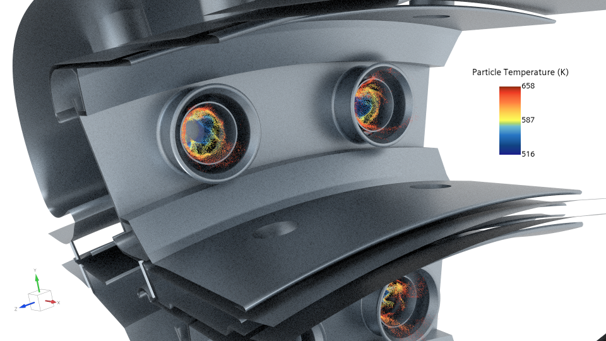
Accelerate liquid fuel injection simulations with GPU computing
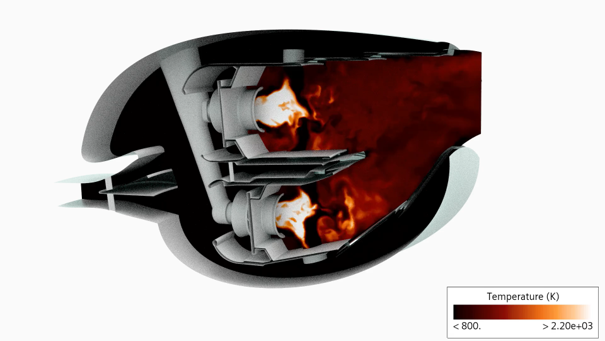
Accelerate complex combustion analysis with detailed chemistry on GPU
GPU-Native Mesh-Based DEM
GPU acceleration is now available for coupled DEM-CFD simulations using the mesh-based Discrete Element Method. Benchmarks show a 3.3x speedup for a fluidized bed case (10 million parcels, 1.5 million cells) comparing 64 CPU cores to a single A100. One GPU node provides the equivalent of 455 CPU cores.
GPU-Native Complex Chemistry
The Complex Chemistry solver now runs natively on GPU for detailed reacting flow applications. Supported turbulence-chemistry interaction models include the Eddy Dissipation Concept (EDC), Laminar Flame Concept (LFC), and Thickened Flame Model (TFM). Clustering is also supported. Benchmarks show a 1.5x speedup for an industrial combustor case (14 million cells) comparing 128 CPU cores to a single A100.
GPU-Native Eddy Break Up (EBU)
The Eddy Break Up combustion model is now GPU-native, with all turbulence-chemistry interaction options supported. Benchmarks show a 5x speedup for a simplified industrial combustor (1.2 million cells) comparing 40 CPU cores to a single RTX 6000 Ada.
GPU-Accelerated Virtual Body Simulations
GPU support has been added for Virtual Body simulations involving Dynamic Fluid-Body Interaction (DFBI). This covers applications such as paint dipping, bottle filling, marine, and aerospace scenarios. The feature is available in conjunction with the Metrics-Based Intersector using the box approach. One GPU node provides 150–200 CPU-core equivalence. Benchmarks show 2.5x and 1.8x speedups for two test cases at 13.5 million and 17.1 million cells, respectively.
GPU-Native Support for MMP Multicomponent Evaporation/Condensation (Spalding)
GPU-native acceleration is now available for Mixture Multiphase (MMP) multicomponent evaporation and condensation using the Spalding model.
GPU-Native Support for VOF Flash Boiling (HRM)
GPU-native acceleration is now available for Volume of Fluid flash boiling using the Homogeneous Relaxation Model (HRM).
GPU Support for Trajectory Motion
Trajectory-motion simulations can now leverage GPU acceleration.
Multi-GPU Support for Simcenter STAR-CCM+ PhysicsAI
The PhysicsAI add-on now supports multi-GPU training and inference. Designed for NVIDIA GPUs, the implementation provides efficient parallel processing. Benchmarks show approximately 3x speedup for both field training and 0D-KPI training when scaling from 1 to 4 NVIDIA A100 cards.
New GPU Hardware Support
Support has been added for two new workstation GPUs:
NVIDIA RTX PRO 6000 Blackwell: Based on the Blackwell architecture, this card offers 96 GB of memory and 1792 GB/s of memory bandwidth—positioned between the A100 and H100 PCIe in terms of bandwidth. It is intended for mid-size models on a single card, with larger models supported by combining multiple GPUs.
AMD Radeon AI PRO R9700: Based on the RDNA4 architecture, this card offers 32 GB of memory and 640 GB/s of memory bandwidth, targeting small to mid-size models.
Better Multi-User Support on Multi-GPU Systems
GPU resource management on multi-GPU systems has been improved. Users can now control GPU visibility using environment variables (CUDA_VISIBLE_DEVICES for NVIDIA, HIP_VISIBLE_DEVICES for AMD), making it easier to allocate specific GPUs to individual users and integrate with HPC management systems.
Improved GPU Sparse Matrix Behavior for Coupled Flow Solver
The coupled flow solver now includes smart handling of sparse matrix storage on GPU. This prevents errors related to sparse matrix overflow and makes full use of available GPU memory without a penalty on memory requirements. The improvement also reduces average time per iteration compared to 2602.
Energy Consumption Monitoring and Reporting
A new built-in feature tracks energy consumption during CFD simulations. It provides insight into energy use per simulation phase, supports optimization of compute resource allocation for operational cost savings, and contributes data for sustainability reporting.
Accelerate hybrid multiphase simulations involving Fluid Film and/or Dispersed Multiphase (DMP) with GPU-native support
Platform: Runtime, Deployment, and Interoperability
New Unified Server/Client Runtime (Now Default in 2606)
A new unified server/client runtime, first introduced as a hidden option in 2602, is now the default in 2606. It replaces complex, error-prone bash launch scripts with robust platform-dependent scripts and delivers performance gains at runtime. It is supported across Linux, Windows, workstation, server, and cloud environments. A fallback to the legacy runtime remains available using USE_RUNTIME_MODE=LEGACY. The legacy runtime is scheduled for removal in 2706.
Enhanced System Diagnostic Utility: "detect"
A new built-in diagnostic tool called detect has been added. It automatically gathers system and software information, generates diagnostic reports, and accelerates troubleshooting. It is activated via a single command line: /[install_path]/star/bin/detect.
Operating System Updates
Added: Windows 11 25H2. Retired: RHEL 9.4 (Linux), Windows Server 2019 (Windows). Scheduled for future releases: RHEL 9.8, RHEL 10.2, Rocky 10.0, Open SUSE Leap 16.0 to be added; Alma 9.5 (ARM) and Rocky 9.5 (ARM) to be retired.
Starting with the 2610 release, the Siemens License Server installer will be removed from the Simcenter STAR-CCM+ installer. Siemens License Server 5.1.0 support is included in 2606.
NVIDIA Volta GPU support will be removed starting with the 2610 release.
MPI Updates
Open MPI 5.0.9 is now certified on Linux. Open MPI 5.0.6 is retired.
Teamcenter Integration
Simcenter STAR-CCM+ 2606 is certified for Teamcenter 2506 and Teamcenter 2512. Asynchronous upgrades of either Teamcenter or STAR-CCM+ are supported within the compatibility range.
Co-Simulation Enhancements
Solid Thermal Conduction Co-Simulation: Fluid/thermal simulations can now be coupled through a solid-to-solid interface, extending co-simulation to solid-solid thermal conduction scenarios.
One-Way FSI Coupling from SPH: SPH CFD solutions can now be used to determine fluid loads on structures. Time series of CGNS files can be exported for scenarios such as vehicle wading.
GPU Compatibility with Co-Simulation Models: Hybrid CPU/GPU mode is now supported for co-simulation, with GPU performance retained for the internal CFD solution across all co-simulation models.
CAE interoperability versions added: Gamma Technologies GT-SUITE Version 2025 and Simulia Abaqus Version 2025.
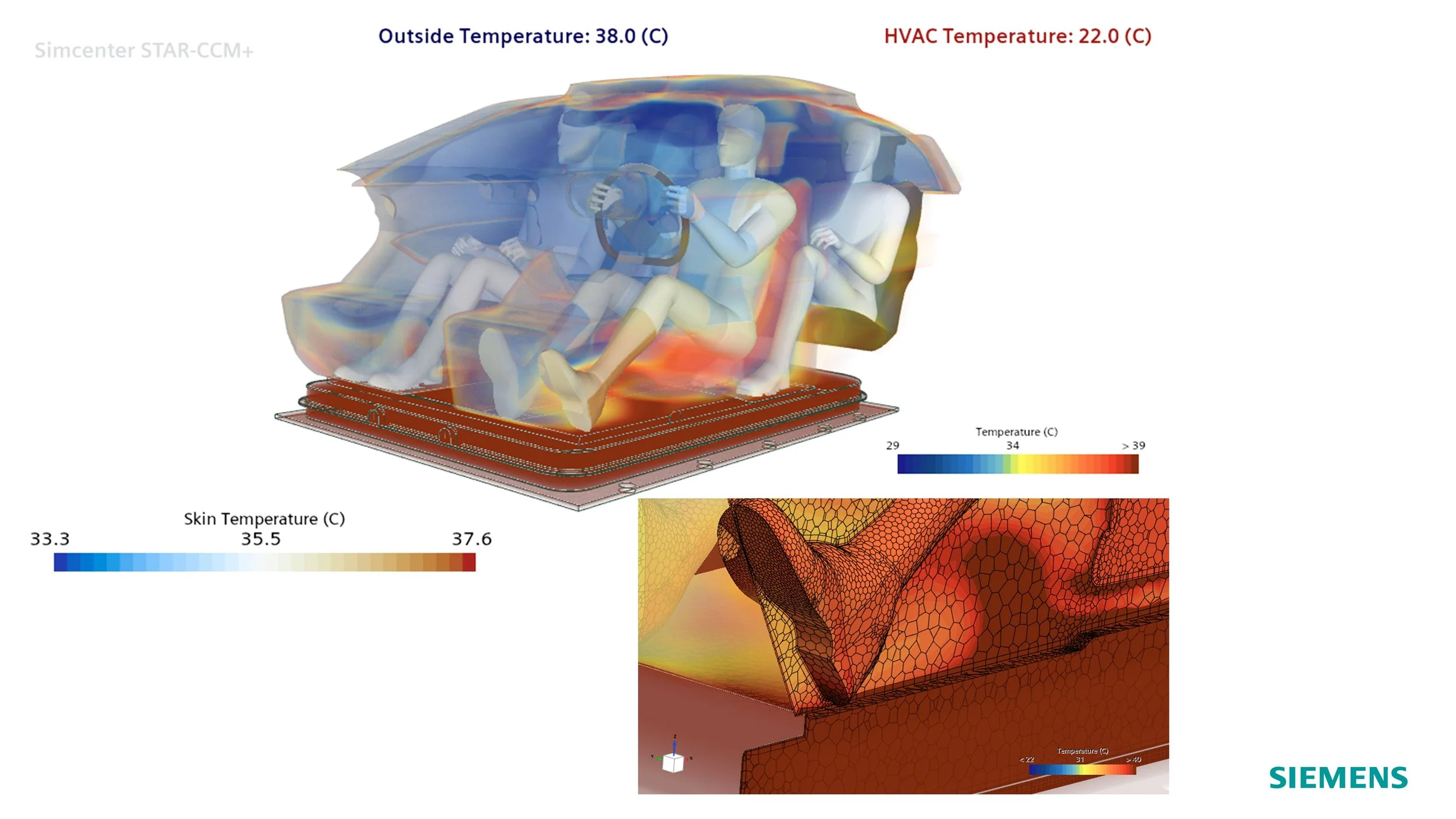
Solid thermal conduction co-simulation: Collaboratively combine fluid/thermal simulations coupled through a solid-to-solid interface.
Design Manager and PhysicsAI
Multi-GPU Support for PhysicsAI
The PhysicsAI add-on now supports multi-GPU training and inference. Designed for NVIDIA GPUs, the implementation provides efficient parallel processing. Benchmarks show approximately 3x speedup for both field training and 0D-KPI training when scaling from 1 to 4 NVIDIA A100 cards.
Kendall Tau Metric for Derived Reports
A Kendall Tau correlation coefficient has been added as a metric option for Derived Reports in Design Manager. It provides a quantitative measure for assessing the accuracy of AI Reduced Order Models (ROMs) by comparing CFD results with AI inferences.
Relaxed Parameter Requirement for .sim File Import
The requirement for parameter matching when importing .sim files into Design Manager has been relaxed, simplifying data integration.
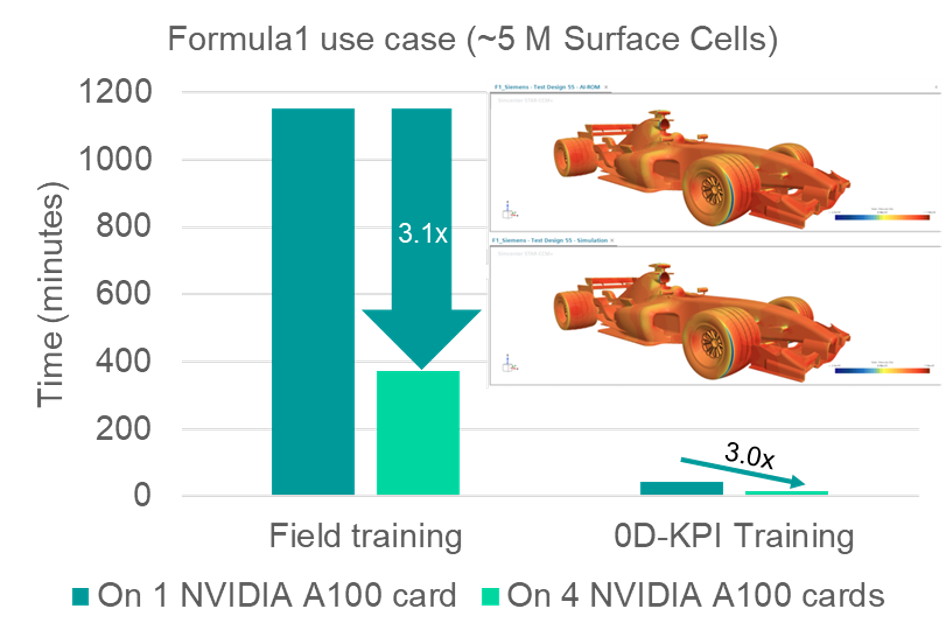
Train AI models multiple times faster and iterate designs with greater confidence
Data Analysis and Visualization
Comparative Data Analysis Using Mapped Field Functions and Solution Histories
A new Comparative Data Analysis workflow allows users to accumulate data from multiple simulations into a single simulation file using Solution Histories and data mapping. This enables comparison of different solver or physics setups and supports in-depth cause-and-effect analysis. Automated Layout creation is included to streamline the visualization workflow, with on-demand layouts that link views to highlight differences.
Studio Scene: Export to Universal Scene Description (.usdz)
Studio Scene content can now be exported to a Universal Scene Description (.usdz) file, enabling use of NVIDIA Omniverse's rendering capabilities to combine simulation results with third-party data. The feature also supports collaboration with Siemens Designcenter NX in mixed reality using a Sony XR Head-Mounted Display.
Studio Scene: Environments and Deep Learning Super Sampling (DLSS)
AI-enhanced visualization using Deep Learning Super Sampling (DLSS) has been added to Studio Scene. This maintains high frame rates for photorealistic scenes. Realistic lighting is available through HDR environment maps, with coordinate system support for aligning the map with geometry.
Simcenter Viewer (Web Viewer-Based Desktop Application)
A new desktop application called Simcenter Viewer replaces the previous Simcenter STAR-CCM+ Viewer (which is removed in 2606). It is based on the Simcenter Web Viewer and can be used in internet-restricted environments. It supports viewer files up to 2 GB with significantly improved framerates. Instant public access via download link is also available.
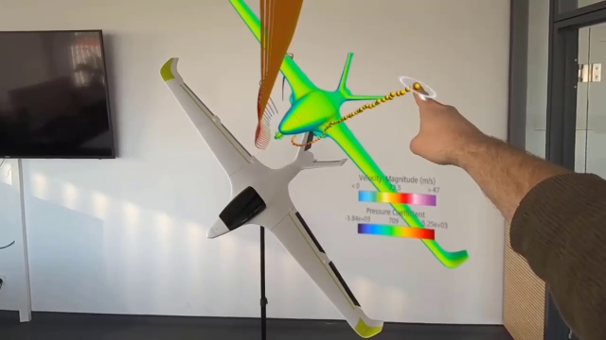
Overlay simulation results on physical products in augmented reality
Mixed Reality and Hand-Tracking for Web Viewer
The Simcenter Web Viewer now supports mixed reality and controller-free hand tracking via MetaQuest3 headsets. Simulation results can be overlaid on real-life objects using passthrough technology.
Additional Data Analysis Enhancements
Plots: A uniform hide/show workflow has been added for all plot data. Data can be shown or hidden individually or in bulk directly from the plot legend, without requiring navigation of the simulation tree.
Coordinate System Support for Resampled Volume: Resampled Volumes now support coordinate systems, allowing better alignment with mesh in simulations involving motion. A motion-following Resampled Volume can store only locally relevant data.
Styling Defaults: The highlighting default (on/off) is now controllable via the home directory. Projection mode can be changed on the fly using the hotkey "P."
Translucency for Field Distributions: Color bars with transparency support have been added for Studio Scene.
Improved Rendering Efficiency for Studio Scene Hardcopies: Ray tracing now uses stochastic sampling to improve quality and reduce hardcopy generation time.
Summary Reordering: Summary Elements can be reordered after initial creation to indicate relevance.
Geometry and Meshing
CAD Interoperability
Updated supported CAD versions include NX up to NX2512.1700, Solid Edge up to 2026, CATIA V5 up to V5-6R2024 SP4, CATIA V6/3DExperience up to R2025x, Creo/Pro-E up to Creo 11.0, SolidWorks up to 2025, Rhino up to 7, JT up to 10.7.1, and Inventor up to 2025.
Metadata Import via Client for Creo: Metadata from Creo can now be automatically imported at the face, body, part, component, or assembly level. Filters allow import of only the needed metadata.
3D-CAD Enhancements
Simplified Face-Pair Selection for Contacts: Face-pair selection can now be made directly from collapsed body-pairs without expanding the tree, reducing clicks and improving efficiency when applying Color, Rename, and CAD Filter operations.
Mismatched Face Pairs Detection: The Contact Browser now flags mismatched face pairs where one face is periodic and the other is non-periodic, providing immediate feedback during contact creation and search to prevent incorrect contact definitions.
Topology Naming Management via CSV: Topology names (Body Group, Body, Face, Edge, Vertex) can now be renamed using CSV file input, and exported to CSV for reuse or external editing. This enables scalable naming across complex models.
Instancing Support for Geometry Modifying Features: Geometry changes can now be applied once and automatically propagated to all instances. Supported features include CAD Repair, Fillet, Move Face, Replace Face, Extend Solid, and Remove Sliver Faces.
Piercing Faces Detection in Search Tool: Piercing faces detection has been added to the 3D-CAD Search tool, enabling early detection of overlaps and coincidences without leaving the CAD environment.
Multi-Instance Body Support: Instanced body creation is now supported across Duplicate Body, Duplicate Body Group, Move, and Rotate operations.
Convergent Model Support for Repair Operations: Repair tools now support edge and face splitting operations for convergent models.
Default Merge Behavior Change: Body interaction now defaults to "None" across post operations such as Extrusion, Body Circular Pattern, Body Linear Pattern, Pattern Along Path, Loft, Revolve, and Sweep.
Assembly Constraints on Mesh: Full support for mesh/faceted bodies, faces, and edges has been added for assembly constraints.
Parts and Meshing Pipeline
Messages Folder for Automated Mesh Operations – Phase 1: A new Messages folder automatically captures runtime errors from mesh operations, presenting a tabulated list of affected entities with exact XYZ coordinates. Persistent diagnostics remain available for post-run analysis. Currently supports surface checks on input surfaces for the surface remesher and volume meshers.
Weak Contact Creation in Boolean Mesh Operations: Weak contacts can now be created directly within Unite, Intersect, and Subtract Boolean operations, automatically generating contacts between output and input parts. This reduces the need for explicit imprinting during mesh preparation.
Grouping of Mesh Operations: Mesh operations can now be organized into folders to better structure and manage the meshing pipeline, while maintaining the existing execution order.
Surface and Volume Meshing
Distributed Memory Parallel Surface Remesher – Phase 1: Phase 1 of the distributed memory parallel Surface Remesher delivers up to 2.1x speedup, with consistent mesh quality and face count across CPU cores. This phase supports the Triangles meshing method and scales effectively up to 16 CPU cores.
Cylindrical Templates for Trimmed Cell Mesher – Phase 1: Flow-aligned grids for cylindrical and annular geometries can now be generated using cylindrical templates within the trimmed cell mesher. This reduces numerical diffusion for higher solution accuracy. The cylindrical template mesh axis is located along the z-axis of the coordinate system; a Cartesian local coordinate system is also supported. Cylindrical template meshes tend to be larger than Cartesian meshes, requiring base size adjustment for mesh parity.
Motion, Overset, and Adaptive Mesh Refinement
2.5D Adaptive Mesh Refinement: AMR is now available in 2.5D environments, enabling fast and economical calibration of refinement criteria before committing to full 3D runs. This supports rapid parametric studies and prototyping.
Nested Virtual Body DFBI Support: Multi-body DFBI motion chains can now be modeled with Virtual Body simulations. DFBI motion specifications can be applied directly to Virtual Body regions as well as boundaries.
Velocity Driver for DFBI Kinematics: A velocity driver has been added for DFBI kinematics, allowing translational motion to be defined using a single scalar value or a time-dependent table. It is compatible with both SPH and Finite Volume frameworks and reduces simulation time by avoiding unnecessary dynamic calculations.
Enable/Disable Option for DFBI Body Coupling via Field Function: DFBI body coupling can now be activated or deactivated using field functions, eliminating the need for custom scripts and reducing the risk of scripting errors.
Virtual Body DFBI Optimization: Run-time performance has been improved for Virtual Body simulations used in conjunction with DFBI.
Faster geometry preparation with piercing faces detection in Search tool
Physics
Faster simulation turnaround with Adaptive Mesh Refinement
Fluid Flow
Metadata Usage Within Field Functions: Part or part-surface level metadata can now be referenced in User-Defined Field Function definitions, with default values available when the metadata key is not found at the part level.
Enhanced Thermal Non-Equilibrium Model with Complex Chemistry: Updated vibrational relaxation time formulation for multi-species environments and dissociation temperature now accounted for in reaction coefficients, improving fidelity for hypersonic thermal non-equilibrium flows.
Updated CCA Default Settings: The Continuity Convergence Accelerator (CCA) now enables Enhanced Stability Treatment by default and uses Generalized Minimal Residuals as the default AMG linear system acceleration method, improving solver robustness for complex flows.
Robust Harmonic Averaging for Anisotropic Thermal Conductivity: Improved stability for thermal cases involving anisotropic thermal conductivity.
Heat Transfer
Simplified Manikin Preparation for Cabin Comfort Studies: Manikin segmentation can now be done without adhering to fixed segment areas. Height, weight, age, and gender selection are now adjustable based on the physiology being simulated.
Nusselt Correlation Method for Dual-Stream Heat Exchangers: A new Nusselt correlation method has been added for heat exchanger performance prediction. An in-built optimization algorithm computes Nusselt parameters from a user-provided Performance Table. This method is aligned with the heat exchanger model available in Simcenter AMESIM.
Common Surface Materials Added to Material Database: Four new entries have been added: Black Body, Transparent, Fully Specular, and Diffusive Reflective surfaces.
Disabled External Radiation on Interface Boundaries with Network Region: External radiation is disabled on interface boundaries with manikins to prevent unphysical radiation options in thermal comfort analyses.
Thermal Resistance Field Function on Contact Interfaces: A thermal resistance field function is now available on contact interfaces, simplifying post-processing of thermal management cases.
Eulerian Multiphase (EMP)
Evaporation, Condensation, and Boiling Compatibility with Phasic Porous Media: Phase change models (evaporation, condensation, and bulk boiling) can now be used within porous material using Phasic Porous Media with EMP. This is compatible with Capillary Pressure and Relative Permeability modeling, targeting applications such as heat pipes and fuel cells.
EMP Adaptive Timestep Providers: A cut-off percentage option has been added for the Large Scale Interface CFL and Smoothed CFL timestep providers, allowing cells producing the smallest timescales to be excluded.
Smoothed-Particle Hydrodynamics (SPH)
Conjugate Heat Transfer: SPH now supports conjugate heat transfer with solid thermal coupling. Full thermal modeling of the fluid and heat transfer to/from walls is included, with fully coupled fluid and solid temperature resolution via the Energy solver. Both direct coupling and a staggered approach with mixed timescales are supported.
Aerodynamic Forcing: A flow field from the Simcenter STAR-CCM+ flow solver can now be mapped to an SPH simulation as a background flow field, with airflow and turbulence influence on the SPH liquid phase handled by the Liu Drag Force model. Both transient coupling and a steady-state snapshot option are available.
Temperature Dependent Dynamic Viscosity: Dynamic viscosity can now be defined as a function of temperature in SPH, using a field function, polynomial, or table.
Inlet with Volume Fraction Definition: Volume fraction at an inlet can now be specified, enabling dynamic inlets such as waves and rainfall to be modeled. Droplet size and frequency can be defined using field functions.
Parameters for CFL Adaptive Time-Step: CFL conditions in Adaptive Time-Step can now be set as parameters, enabling easier automation and consistency with the Finite Volume workflow.
Translation Motion: Solid parts, inlets, and outlets now support translation through the Tools > Motion menu.
Data Analysis – Particle Refinement: Iso Surface discretization now adapts to particle size instead of using a uniform cell size.
Velocity Stabilization Update: The Basic and Advanced options for Velocity Stabilization are replaced by the Universal option and will be removed in the next release.
Simulate wind driven sprays or interaction with turbulent airflow
Lagrangian Multiphase (LMP)
Built-In Stokes-Cunningham Drag Model: A built-in Stokes-Cunningham drag model has been added for low Reynolds number flows of particles in rarefied gases, targeting applications such as dust/contamination control in semiconductor manufacturing and microfluidics devices.
Eulerian Velocity Interpolation Option: Fluid velocity interpolation for Lagrangian solvers can now be disabled on fine meshes with large parcel counts to achieve up to 10% faster simulations, where accuracy gains from interpolation are negligible.
Discrete Element Method (DEM)
Improved Template Phase Interactions for Particle Clumps and Fibers: New templates have been added: 'DEM Clump-Clump Interaction' and 'DEM Fiber-Fiber Interaction.' Automatic creation of phase interaction when the 'Particles Clump' model is selected has been disabled. Rolling Resistance is no longer automatically added for clumps, fibers, and other non-spherical particles.
Reacting Flows
Improved Heat Release Rate Field Function for Flamelets: A new expert option provides higher accuracy for the heat release indicator field function, with improved similarity to the Complex Chemistry calculation of Heat Release Rate, at increased computational cost.
Relax to Chemical Equilibrium (RTCE) as Standalone Model: RTCE can now be selected as a standalone model, providing a clearer distinction between combustion models. Previously it was only available as an approximation option under the Complex Chemistry node.
Mixture Multiphase (MMP) and Flamelet Compatibility: MMP and flamelet models are now compatible, enabling future use of MMP in fuel spray modeling.
Improved Stability of Coupled Flow with Flamelet Generated Manifold (FGM): A new pseudo-time term for the flamelet and coupled energy equations provides faster and smoother convergence.
Electrochemistry
3D Cell Design: Extended Field Functions for Cell Voltage Drops: Two new field functions have been introduced: Plett Hysteresis Overpotential and Subgrid Particle Concentration Overpotential, providing greater insight into battery cell behavior.
Structure Mechanics
Anand Creep Model: The Anand material model has been added for predicting visco-plastic responses under thermal cycling, creep, and stress relaxation. It is well-suited for solder alloys and materials operating at high homologous temperatures.
Structural Shells: Plasticity: Plastic deformation modeling has been added for thin structures using enhanced through-thickness integration for shell elements (Quad4/Tri3). Five integration points through the thickness capture peak stresses where plasticity initiates. Accuracy is comparable to quadratic hex elements (Hex20) at over 2x performance.
Surface from Volume Mesh Operation: A new mesh operation creates a high-quality surface at the fluid-solid interface for FSI simulations, minimizing the gap between fluid mesh vertices and the solid surface and simplifying fluid-side remeshing.
Multiphysics Orchestrator: Robust and efficient FSI simulations for strongly coupled multiphysics problems are now supported through converged data exchange between fluid and structure domains. Advanced stabilization and acceleration schemes, including Quasi-Newton with Anderson acceleration, are enabled. The user can define whether the fluid or solid domain leads.
Additional Structure Mechanics Enhancements: Static analyses of models constrained only by rigid contact are now enabled. A new "Constraint direction" vector field function visualizes the primary-to-secondary constraint direction. Automatic validation of orthotropic elastic coefficients issues a warning if non-physical values are detected. Consistent naming of material coefficients for anisotropic materials now follows the same convention as for isotropic materials. Greater control over displacement convergence tolerances in the fluid-structure coupling solver has been added. New "Shell Resultant Contact Force" and "Shell Resultant Rigid Body Force" field functions are introduced. Fluid-to-solid FSI coupling is now enabled for Structural Shells.
Electromagnetics
Finite Element Magnetic Field Solver – Phase 1: A new Finite Element Magnetic Field (FeMF) solver has been introduced as the next-generation electromagnetics solver in STAR-CCM+. It is designed for efficient, accurate computation of high-fidelity magnetic fields, with particular emphasis on e-motors and transformers. Benchmarks show a 10x faster solve time compared to the existing solver for a 3D motor benchmark case.
Capabilities in the initial Phase 1 release include: steady and implicit unsteady time domain; permanent magnet (linear) and current-driven excitation coils (open/closed, stranded/solid); isotropic linear and nonlinear permeability; linear electrical conductivity; symmetry and periodic boundary conditions; post-processing of coil reports, magnetic torque, electromagnetic field quantities, and Ohmic and Steinmetz losses; and a parts-based workflow with EMAG-Thermal coupling.
Improved p-Order Specification: The polynomial order specification on regions has been extended, with a profile function method for space/time-dependent order settings.
Temperature-Dependent Non-Linear Steels: The sensitivity of the nonlinear B-H response to temperature is now supported in transient finite element magnetic solvers, relevant to e-motor and power transformer EMAG-Thermal workflows.
Extended Electrostatic Force Density Calculation to Boundaries: Electrostatic force density calculation on boundaries has been extended to simplify user workflows.
Strategic Applications
Acoustics
Native Frequency Solver: A new native Frequency Solver for acoustics has been added, providing an all-in-one frequency domain tool that removes the data transfer burden between separate applications. It covers pure acoustics (e.g., exhaust noise) and HVAC duct interior cabin noise.
Noise Source Weighting and Acoustic Damping Coefficients – UI Changes: Two region settings have been renamed for clarity: Noise Source Weighting Coefficient is now Sound Source Weighting, and Acoustic Damping Coefficient is now Sound Wave Damping.
E-Powertrain (Battery and Thermal Runaway)
Thermal Runaway – Interaction Between Heat Release and Venting Models: Heat Release and Venting models are now physically coupled when using Arrhenius Pseudo or Multi-Reaction models. Vent gas mass, internal pressure, and temperature are computed directly from reactions. Automatic vent triggering based on reaction-driven pressure rise includes choked/subsonic flow detection. Enhanced vent opening control includes vent opening pressure, discharge coefficient, and time-accurate options.
Thermal Runaway – Allow Heat Release Model to Act as Heat Sink: The Heat Release model can now model negative heat rates, enabling the battery cell to act as a heat sink for increased fidelity in thermal runaway simulation.
Automated Battery Module Reports Extended: The "Create Battery Module Reports" command now supports additional Heat Release model field functions: Battery Heat Release Model Pseudo Reactant Concentration and Battery Heat Release Model Pseudo Reaction Rate.
In-Cylinder
Cone Angle Sampling Polynomial Exponent for Nozzle Injectors: A new parameter available in the In-Cylinder user interface allows customization of the spray plume generated by Nozzle injectors, including per-nozzle customization. The exponent specifies the polynomial used in the sample density of parcels. A higher value biases distribution toward the centerline; unity represents uniform distribution.
Visual Confirmation of Replace Geometry and Update Operations: Messages are now added to the main output window upon completion of Replace Cylinder and Valves Geometry and Update operations.
Herweg-Maly Turbulent Flame Speed Correlation: The Herweg-Maly method has been added to the In-Cylinder panels alongside the existing Zimont and Peters approaches for the Damköhler number-based turbulent flame speed correlation. It is particularly applicable to hydrogen combustion.
Clustering Component Selection and Customization in In-Cylinder Panels: Clustering components are now accessible directly in the In-Cylinder Solution user interface, eliminating the need to access the main simulation tree for setup.
Lower Opacity of 10–90% Combustion Duration in Histogram Plot: Visual distinction between 10–90% combustion duration and 10–50–90% mass fraction burnt in histogram plots has been improved.
Turbomachinery
Structured Mesh CGNS Import with Family Names: Family names in CGNS files are now imported and stored as Tags. An additional macro can be used to merge regions and boundaries based on the imported Tags.
Turbomachinery Import Workflow – Radial Machine: The Turbomachinery Import Workflow now supports radial blade spline data, extending application coverage to centrifugal machines, radial/mixed pumps, steam turbines, and hydro turbines. Splitter blade and blunt trailing edge configurations are supported.
Turbomachinery Import Workflow – Hub/Shroud Polyline Definition: Increased flexibility for hub and shroud definition through polyline input.
User Guide and Tutorials
New tutorials added in 2606 include:
Multiphase Flow: Eulerian – Oil Drainage in a Heterogeneous Porous Medium
Multiphase Flow: SPH – Oil Flow in an Electric Motor
Solid Stress: Plasticity for Continuum Shells – Hydroforming
Acoustics: Finite Element Acoustics – Simplified Muffler
Acoustics: Finite Element Acoustics – Time-Frequency Coupled HVAC Noise Analysis
Electromagnetism: Finite Element Magnetic Field – E-Machine
The VOF: Gravity-Driven Flow tutorial has been retired. Modified tutorials include VOF: Tank Sloshing with Adaptive Meshing, Acoustic Wave Modeling: Noise from a Cylinder, and Eulerian Multiple Flow Regimes: Pressurized Water Reactor.
Simcenter STAR-CCM+ 2606 is available now. For pricing, licensing options, or questions about specific capabilities, contact the Resolved Analytics team at resolvedanalytics.com/contact. The next scheduled release is Simcenter STAR-CCM+ 2612, targeted for December 2026.