
Performance, Physics, and Productivity: A Methodical Breakdown of the Simcenter STAR-CCM+ 2602 Release
The release of Simcenter STAR-CCM+ 2602 introduces over 550 new features and enhancements organized around the themes of modeling complexity, exploring possibilities, going faster, and staying integrated. Below, the new features are broken down in a few different ways. If you want to do a deep dive, you can check out the detailed release notes.
⭐ Top Features in Version 2602
⏩ Go Faster with Efficiency and Performance
This is arguably the most significant area of technical advancement in this release. The focus is on slashing turnaround times through:
Massive GPU Expansion: Making the VOF (Volume of Fluid) and MMP (Mixture Multiphase) solvers GPU-native, alongside expanded support for CHT and Segregated Species.
HPC Optimization: Introducing simulation compression to save storage and multi-node GPU support for complex particle simulations (DEM).
🤖🤖 Model Complexity with Physics Fidelity
The update expands the "digital twin" capability by allowing engineers to model more intricate physical phenomena:
Multiphase Realism: Enhanced SPH (Smoothed-Particle Hydrodynamics) for vehicle wading and better energy conservation in turbomachinery interfaces.
Electronics and Powertrain: Advanced thermal runaway modeling for batteries and multi-port solid conductor models for electromagnetics.
🖥️🧭⏲️ Explore Possibilities with Innovation and Optimization
The release focuses on making design exploration faster and more automated:
Integrated PhysicsAI: Allowing for rapid design assessment using trained neural networks directly within the Design Manager.
Adjoint Speed: Streamlining topology optimization to reach optimal designs up to 3.2x faster.
➕🌐💬💻 Stay Integrated with Connected Workflows
The final focus is on the ecosystem surrounding the simulation:
AI-Driven Support: The introduction of an AI-powered chat for instant documentation and best-practice guidance.
Enhanced Data Sharing: New tools like the Web Viewer layout support to bridge the gap between simulation experts and stakeholders by combining qualitative and quantitative data in one view.
Table of Contents:
Platform and User Experience
AI-Powered Chat
Simulation Compression
Stage Comparison
Simulation Guide Improvements
High-Performance Computing (HPC) and GPU Acceleration
VOF and MMP on GPU
Accelerated Solvers (CHT & Segregated Species)
Discrete Element Method (DEM)
Expanded Hardware Support (AMD & NVIDIA Blackwell)
Adaptive CPU Utilization
Geometry and Meshing
3D-CAD Enhancements (Logo Removal & Assembly Constraints)
Meshing Quality (Enhanced Quality Prisms)
Directed Mesh
Physics and Solvers
Adjoint Optimization
Heat Transfer Improvements
Structural Mechanics (Contact Detection & Iterative-Direct Solver 2.0)
Electromagnetics
Design Manager and Data Analysis
Geometric Deep Learning (PhysicsAI)
Simcenter Web Viewer Layout Support
Plot Customization
Industry-Specific Solutions
E-Powertrain (Thermal Runaway Modeling)
SPH (Vehicle Wading)
Turbomachinery (Energy Conservation)
Enhanced Platform and User Experience
AI-Powered Chat
Users of Simcenter X Advanced now have access to an AI chatbot that provides instant support for product documentation, modeling fundamentals, and best practices.
Advanced Simulation Compression
New multi-threaded compression automatically reduces simulation file sizes to save disk space and speed up file transfers. In benchmark tests, a 100.08 GB file was compressed to approximately 57 GB in 4.5 minutes using 32 cores.
Automated Stage Comparison
A new tool allows users to verify differences between simulation stages, such as comparing steady and unsteady setups, to reduce manual error.
Improved Simulation Guides
Enhancements include a dedicated tree icon for quick access and the ability to open guides simultaneously with the simulation file.
High-Performance Computing (HPC) and GPU Acceleration
GPU-Native VOF and MMP Solvers
The Volume of Fluid (VOF) and Mixture Multiphase (MMP) solvers are now GPU-native. Benchmarks show that a single NVIDIA A100 or RTX 6000 Ada GPU can provide more than 200 CPU core equivalence, with tank sloshing tests showing 251 CPU core equivalence and energy usage at 19% of equivalent CPU setups.
Accelerated Conjugate Heat Transfer (CHT) Solvers
GPU porting of Table(T,p) property methods enables up to 5x faster simulations for heat exchangers and vehicle thermal management.
Segregated Species Solver
Multi-component fluid transport simulations on GPUs showed a 2.7x speedup in membrane gas separation cases.
GPU Accelerated Discrete Element Method (DEM)
GPU acceleration for non-spherical particles (caplets, capsules, fibers) provides up to 630 CPU core equivalence for a single GPU node.
Expanded Hardware Support
AMD GPUs: Support is extended to Windows workstations, with one AMD W7800 GPU performing similarly to over 115 reference CPU cores.
New Architectures: The release supports NVIDIA Blackwell (B100, B200, GB200) and GB10 GPUs.
Adaptive CPU Utilization
Software now makes better use of idle CPU cores to assist threaded GPU applications, such as sliding mesh simulations, resulting in up to a 10% performance gain.
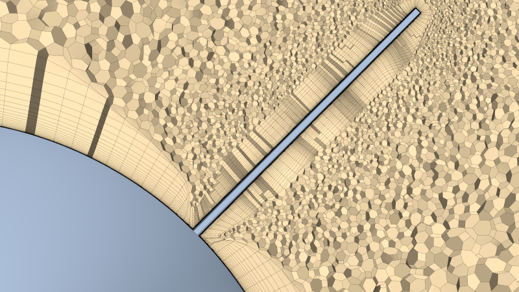
“Enhanced Quality Prisms” is a new option under the prism layer mesher that aims to improve the boundary layer mesh quality in concave/convex corners.
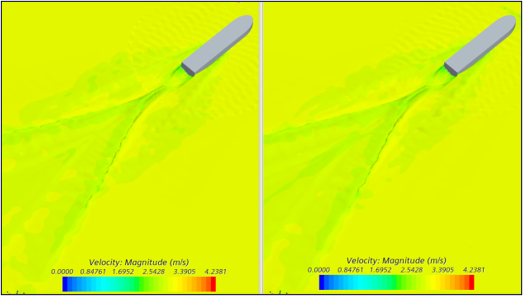
Better accuracy, sharper results. 2602 introduces second-order time support for Virtual Bodies to master complex, time-dependent fluid flows
Streamlined Geometry and Meshing
Automated Logo Removal
Small embossed or debossed features can be automatically identified and removed to simplify surface preparation.
Parametric Assembly Constraints
New geometric constraints allow for parametric positioning of bodies, ensuring assemblies remain consistent during design changes.
Enhanced Quality Prisms
This option provides more robust prism layer generation with smoother transitions to the core mesh and built-in aspect ratio control.
Directed Mesh Automation
Setup is accelerated through the automatic selection of source and target surfaces, even for geometry with numerous parts.
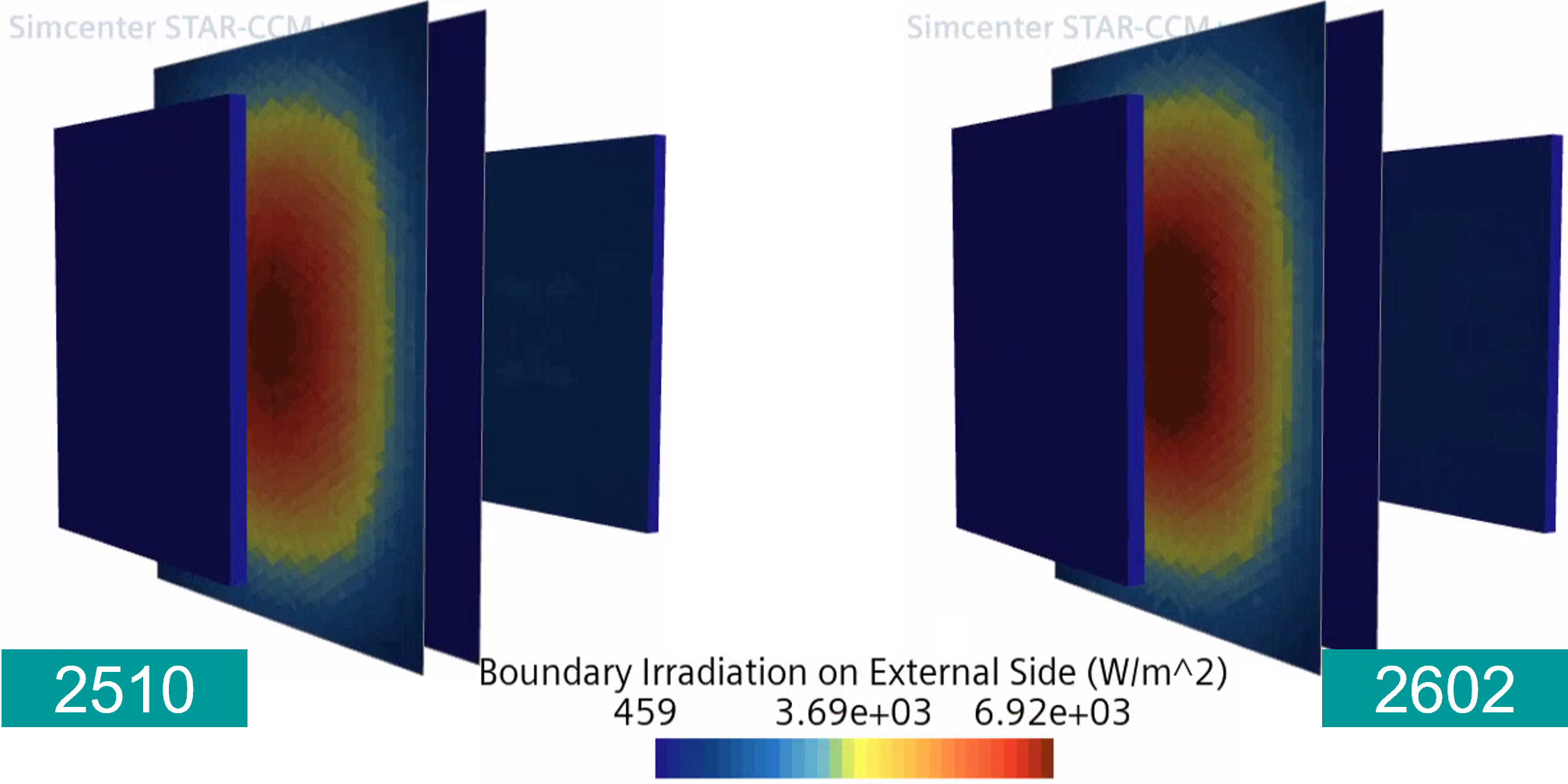
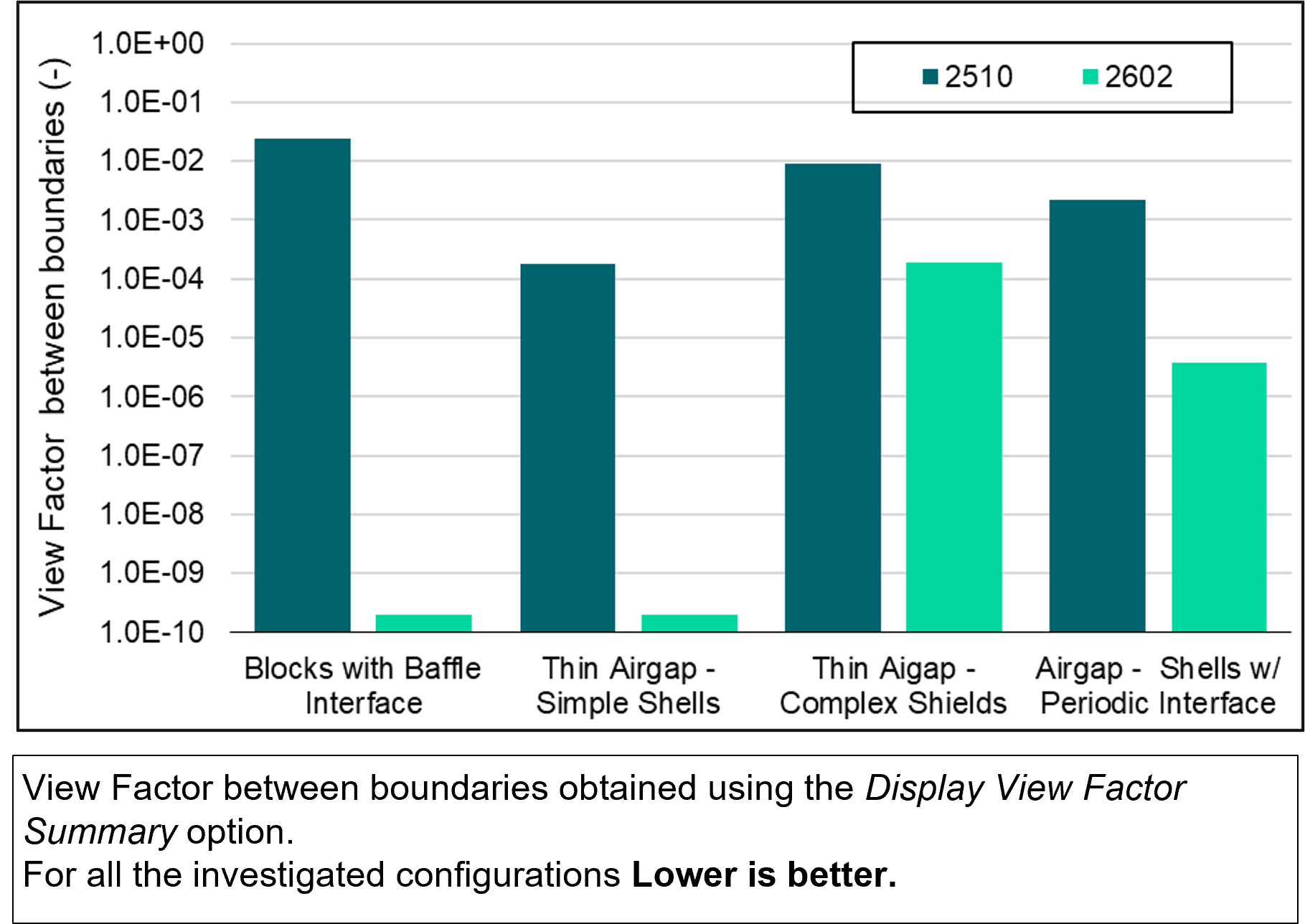
In Simcenter STAR-CCM+ 2602 the View Factor algorithm behavior in the presence of thin gaps between boundaries was improved to ensure the highest possible accuracy when dealing with radiation going through thin gaps.
Physics and Solvers
Fast Adjoint Optimization
A new "Update Topology" operation streamlines optimization studies by avoiding unnecessary concurrent calculations, resulting in up to a 3.2x faster turnaround time for cases like 3D bended pipes.
Heat Transfer
Improvements to the View Factor solver enhance ray-tracing robustness for very thin gaps, impacting Surface-to-Surface and Photon Monte Carlo radiation models.
Efficient Contact Detection
Optimization limits detection to surfaces in close proximity, providing up to a 15% runtime reduction in structural mechanics.
Iterative-Direct Solver 2.0
Delivers up to a 2x speedup over version 1.0 and up to 3.2x faster performance than the MUMPS solver.
Electromagnetics
Features a new multi-port solid conductor model for voltage-driven systems and a regularization-free linear solver to ensure current conservation.
Accelerate design process with integrated 3D AI Reduced Order Models
Design Manager and Data Analysis
Integrated PhysicsAI
Geometric Deep Learning is now integrated into Design Manager, allowing users to assess design variants in minutes using neural networks trained on existing simulation data.
Simcenter Web Viewer Layouts
New layout support enables sharing qualitative scenes and quantitative plots in a single interactive, shareable file.
Plot "Quick Actions"
New plot-centric actions allow for direct property changes without navigating the deep simulation tree.
Faster turnaround time for vehicle wading applications through the SPH solver
Industry-Specific Solutions
E-Powertrain
Enhanced thermal runaway modeling includes multiple pseudo-reaction support using Arrhenius-based kinetic equations.
Wading Simulations- SPH (Smoothed-Particle Hydrodynamics)
New vehicle wading capabilities allow for the simulation of dynamic car motion, including suspension and tire-road contact, with mechanical stress analysis
Improved Turbomachinery
Improved energy conservation at implicit mixing planes is achieved through imprinting bins into interface discretization, eliminating pressure and temperature discrepancies across interfaces.
Try Simcenter STAR-CCM+ 2602 Today
📌Want to see it in action? Explore the full release notes or contact us for more details. Purchase STAR-CCM+ now directly online!
💡 Looking for more CFD insights? Check out our latest case studies and CFD Insights blog articles.