
A Guide to Estimating the Organizational Costs of Computational Fluid Dynamics (CFD) Simulations:
Software, Hardware, and Personnel (2026 Guide)
CFD COSTS:
The total cost of a Computational Fluid Dynamics (CFD) simulation depends on three components: software licensing, computing hardware, and engineering personnel. For most organizations, personnel costs dominate — a qualified CFD analyst costs approximately $95,000 per year in base salary with a typical 2.0x overhead multiplier for total loaded cost. Commercial CFD software licensing ranges from $10 to $35 per hour per active simulation, and cloud computing costs approximately $0.05 to $0.20 per CPU-hour. The most cost-effective model depends on simulation frequency: in-house capability for continuous workloads, co-sourcing for growing programs, or project-based outsourcing for intermittent needs.
| Cost Component | In-House | Co-Sourced | Outsourced |
|---|---|---|---|
| Software Licensing | $15,000 - $50,000+/year | $0 - $25,000/year (may use client's licenses) | $0 (included in consulting fee) |
| Computing Hardware | $5,000 - $20,000 (workstation + cluster access) | $2,000 - $10,000/year (shared cloud) | $0 (included in consulting fee) |
| Personnel | ~$190,000/year (salary $95K x 2.0 overhead) | $100 - $200/hr (blended rate) | $100 - $250/hr (project rate) |
| Estimated Annual Cost (8 projects) | $210,000 - $260,000 | $80,000 - $160,000 | $40,000 - $200,000 |
| Best For | Continuous workload (8+ projects/year) | Growing programs with knowledge transfer needs | Intermittent or specialized projects (<6/year) |
Cost estimates based on typical U.S. market rates for mechanical/thermal CFD analysis. Actual costs vary by application complexity, software platform, and geographic region. Personnel overhead multiplier of 2.0x includes benefits, facilities, management, and training.
Table of Contents
This guide will walk you through the process of estimating costs associated with Computational Fluid Dynamics (CFD) simulations.
Understanding Your Needs
Software & Hardware Costs
Personnel Costs
Co-sourcing: A Cost-Effective Option
Use Case: Technology Developer
Use Case: SME Manufacturer

While the use case and needs analysis will provide the basis of a CFD acquisition strategy, there are several potential hardware, software, and manpower combinations that can meet any simulation requirement.
Understanding Your Needs
It’s no secret that CFD and other forms of computational engineering provide a competitive edge, but knowing how your organization will leverage simulation is critical to understanding future costs.

What Determines Your Needs?
The business case for computational engineering simulation tools such as CFD is very company specific. Most commonly, value is derived by reducing time to market with new or improved products and lowering the costs of development by reducing the need for physical prototyping. The effort and resources that will be required in such a program is strongly dependent upon the number of products in the development cycle, the targeted performance levels, and the company’s skill in applying simulation technology.

Software and Hardware Costs
Match Your Physics Needs, Team Capabilities, and Budget
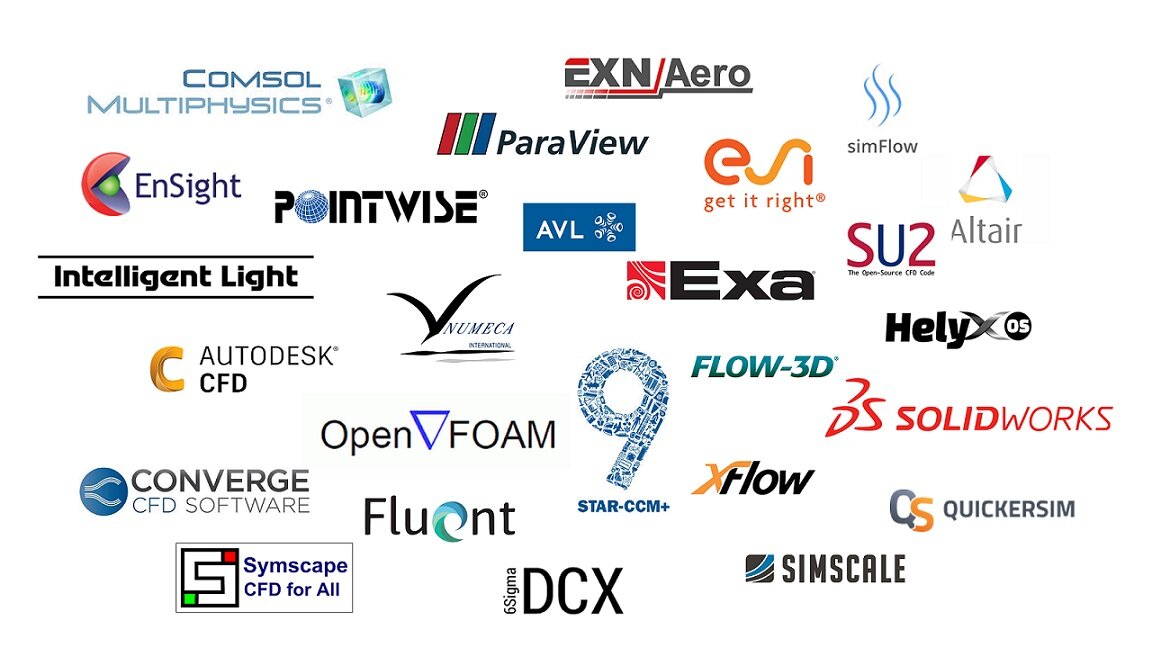
You can also read our 5-part series on Comparing CFD Software in which we’ve broken down some of the more widely used packages and their capabilities based on a combination of first-hand experience, research, and user surveys.
How do you find the best CFD software for your company?
CFD software packages generally fall into one of the following five broad categories; opensource, open-source wrappers, CAD integrated, specialty, or comprehensive. Your needs analysis, personnel capabilities, and cost considerations will drive decision making. The physics you need to simulate in order to achieve your project objectives is a relatively simple filter to apply that should help reduce the number of options available to you right away. For example, if you are intending to model open-surface flows, your options are quickly reduced to only those codes able to perform Volume-of-Fluid (VoF) calculations. Most software companies do a good job of describing what physics they are capable of modeling.
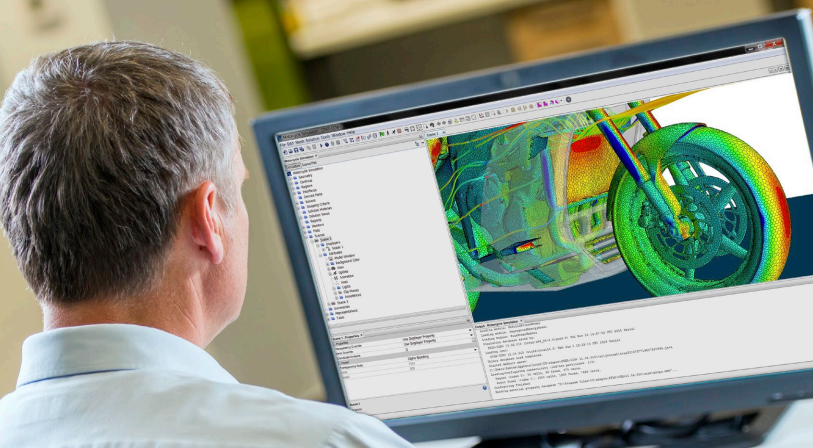
How Much Does CFD Software and Hardware Cost?
A second filter that can be applied is that of personnel capability. Open-source solutions are well-known for their cost-effectiveness at scale but are also equally well-known for their lack of ease of use. The most common open-source software, Open-FOAM, is command line and text file driven, lacking either native pre- or post-processing Graphical User Interfaces (GUIs) and is currently only available for Linux operating systems. Users without the patience for the workflow disruptions that result or the skill to overcome common challenges in these regards are advised to steer away from open-source software.
Commercial licensing costs are highly variable with product sophistication, estimated to fall in the broad range between $10 and $35 per hour per active simulation. High-fidelity models running in parallel across dozens of cores are in the higher end of this range. Cloud based licensing aligns closely with this pricing band. Hardware costs are estimated between $0.05 and $0.20 per cpu-hr and include costs from power, cooling, and depreciation. Though hardware costs continue to decrease over time, they can still represent a substantial upfront cost when needs require a small CFD cluster or top-end workstation. Several cloud computing service providers now exist that can lower or eliminate the need for upfront capital expenses and some commercial CFD software companies can now be accessed as a pay-as-you-go resource, which is convenient for teams with variable or project-based workloads.
Personnel Costs

CFD simulations demand highly skilled engineers, significant planning effort, and careful resource utilization. With salaries, overhead, and IT support included, engineering labor often represents the largest portion of CFD program expenses.

Is it cheaper to hire a CFD engineer or a CFD consultant?
CFD simulations are personnel intensive. The effort level that is required is dependent upon the complexity of the simulations needed, the acumen of the simulation engineer, the software and hardware used, and the documentation requirements. A qualified CFD engineer has an advanced degree in an engineering discipline and more than 5 years of experience in applying CFD to industrial scale problems. Using their expertise, they will not only perform analyses but will also provide leadership in advancing company goals, planning, and coordinating analyses in order to meet company objectives. A CFD engineer’s workload can be erratic. Most of the effort in a study is spent initially in understanding project objectives, planning the analysis process and outputs, and setting up initial simulations. After submitting a simulation for execution, the simulation engineer must then sit and wait for a result. In some cases where simulations take multiple days, it is important for the CFD engineer to be post-processing previous runs or pre-processing future runs in order to maintain a high utilization rate.
Becoming highly skilled in balancing workloads with hardware and software resources takes many years of practice. In addition, if CFD requirements are up and down throughout a year, CFD engineers may face extended periods where these skills are not being used. Engineers must be multifaceted, and companies must be creative in their use of this downtime in order to maintain respectable rates of utilization. In our experience, a utilization rate of ~80% is about as high as can be expected. After subtracting standard vacation and other administrative tasks, overall utilization rates of ~60% are expected. With a representative salary of $95,000 / year, and a typical company overhead ratio of 2.0, it is obvious that CFD engineering personnel costs make up the majority of the total cost of ownership of CFD. In addition, IT personnel will be needed to maintain internal or external computing resources and software. A representative IT cost of 10% of CFD engineer costs is assumed here.

Outsourcing CFD
Given the high costs of ownership associated with CFD, it is natural to ask if out-sourcing, or, more appropriately, co-sourcing of CFD is the optimal solution for some companies.
When should I outsource CFD?
Given the high costs of ownership associated with simulation, many companies are evaluating whether outsourcing or hiring a CFD consulting partner is the more efficient path. While traditional outsourcing can feel like "throwing it over the wall," a CFD consultancy acts as a strategic extension of your team.
CFD consulting allows for the formation of ad hoc teams where internal staff and external specialists work together to solve complex thermal and fluid challenges. In this partnership, the CFD consultant works alongside—but doesn’t replace—your existing staff, providing the specific technical skills needed to move a project forward. Once the objective is met, the engagement concludes, providing your firm with maximum flexibility.
By utilizing outsourced CFD engineering, an in-house team can retain control over core internal processes while relying on an external specialist for high-end technical modeling. This model helps companies avoid the overhead of full-time hiring, specialized software licensing, and the burden of training personnel for resources that may only be partially utilized.
Cost and Efficiency Advantages
Managing your simulation needs through a CFD consultant offers clear advantages in both cost and scale:
For Hardware Startups: Engaging a CFD consultant can save approximately $30k in software and specialized labor costs, freeing up internal engineers to focus on prototype development and critical path items.
For SME Manufacturers: On-demand CFD services can save ~$20k annually by eliminating the "idle time" costs of software seats during periods of low demand.
Beyond the balance sheet, projects are often completed faster. Products reach a higher level of optimization due to the consultant’s deep technical expertise, access to high-performance computing (HPC) hardware, and streamlined workflows.
Deciding between in-house simulation and CFD outsourcing isn't a one-size-fits-all choice. Every business has unique requirements, and a thorough understanding of your core goals is the first step in making the right sourcing decision.
Schedule your free CFD needs analysis today in order to better
understand the costs of CFD to your organization.
“Co-sourcing has clear cost and scale advantages, and managed correctly, it will let you refocus your organizations resources on areas that drive growth.”
-Matthew Griffin, Business Advisor in Emerging Technologies
CFD Use Case: Technology Development Company
We have worked with several inspiring entrepreneurs developing novel technologies in energy, industrial and consumer product markets over the past few years. These companies spend lots of time and money in product development. The simplest products may cost $100k–500k to develop and take around 9-12 months. More complex products can cost millions and take years. The “typical” hardware startup, if such a thing exists, spends between 1 and 2 years in technology development and prototyping.
During this time, designs should be in rapid, iterative development, seeking a balance between simulated product performance and market expectations and costs. Incremental improvements in performance or reductions in cost during this stage can mean huge cost basis savings later.
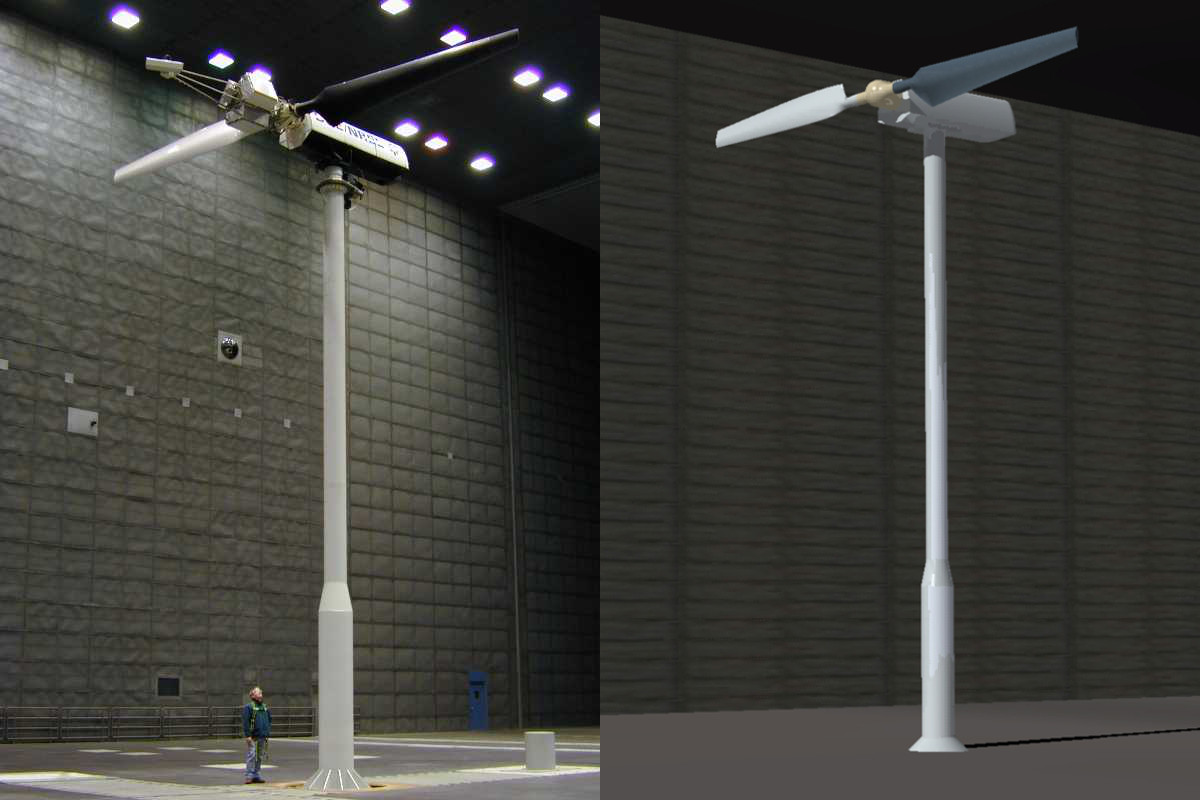
For early-stage startups, simulation needs often come in bursts. Engineering development may slow when team members are focused on supporting grant writing, market needs analyses or other important startup tasks. Activity may then suddenly explode when resources become available or as new concepts materialize. The computational burden will be heavily dependent upon the physics that must be modeled to ensure accuracy.
Using CFD at a Hardware Startup Company
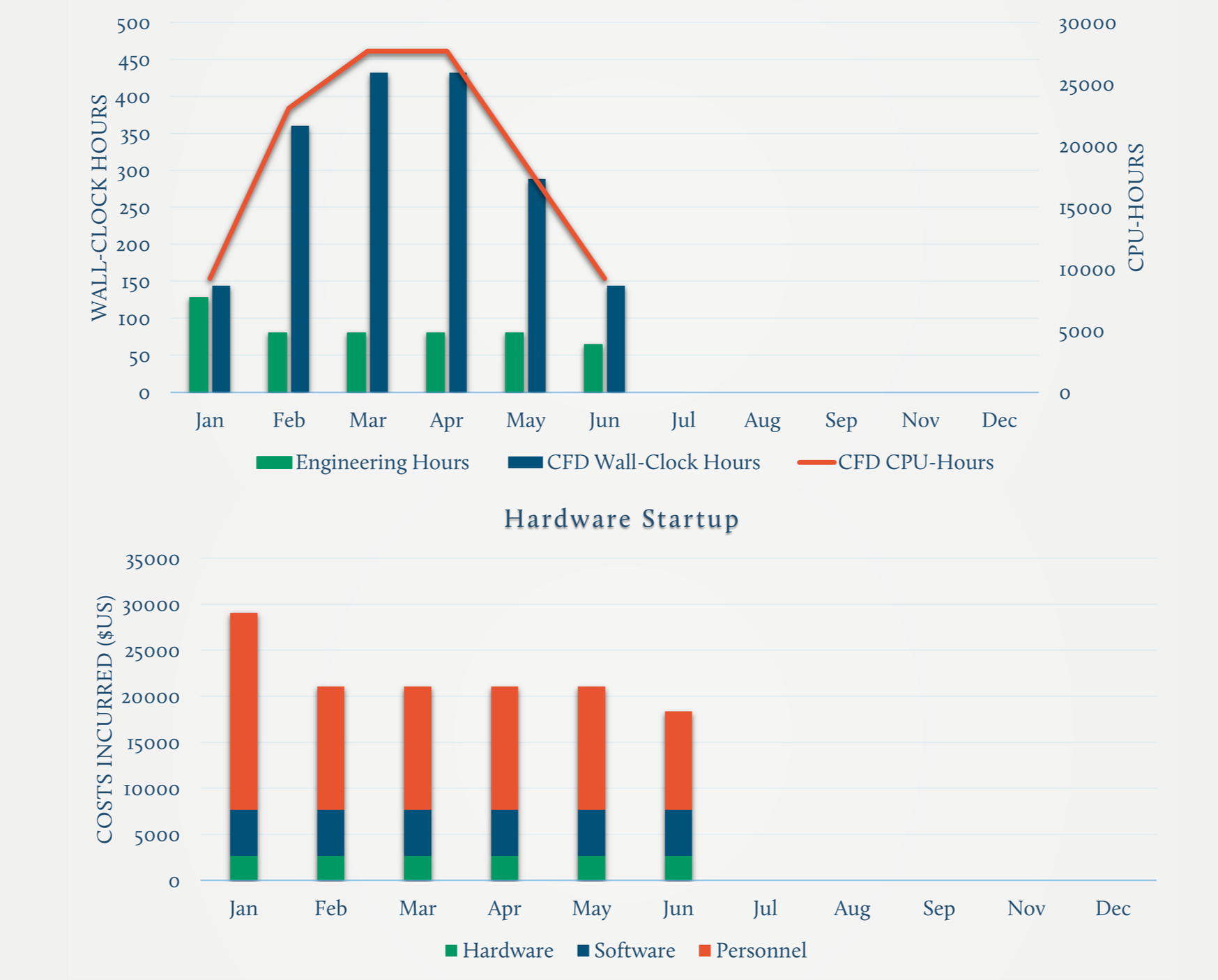
Here we consider the hypothetical example of a small team developing a novel wind turbine technology. The team has recently secured a Small Business Innovation and Research (SBIR) grant for further development and proof-of-concept of its technology. CFD modeling will be used to identify the dimensional parameters and power take-off damping coefficients that result in maximum power output at lowest cost. Up to ~100 unique, time-dependent CFD simulations coupling air flow with turbine motion should be expected. Each simulation will be run for 30 turbine cycles to ensure converged statistics requiring ~1000 CPU-hours on a 6M cell computational grid. On average and including initial model setup overheads, each simulations will require between 3 and 5 hours of engineering personnel time, depending upon skill level.
The CFD work is performed in the first 6 months or so of the SBIR project period and engineering hours would be heavily weighted towards the first few weeks of the project during model development. The exacting physics required, including time-dependent Fluid-Structure Interaction (FSI) make the comprehensive CFD packages the clear choice. A 6-month fixed cost license at $30,000 is assumed. The relatively small cell count makes a 64-processor server with a cost of $16,000 fully depreciated over the course of the project a good choice. Estimated CFD engineer and computing workloads as well as costs are shown in the following slide.
CFD Use Case: SME Manufacturing Company
Ninety-seven percent of U.S. manufacturing firms— more than a quarter-million of them—have fewer than 500 employees. Unfortunately, small and medium-sized enterprises (SMEs) make very limited use of modeling and simulation. SMEs often need significant hands-on support and training to fully realize the potential of incorporating simulation into their business operations.
For SMEs, simulation needs range from one time verification of a product or process to continuous use in early-stage technology development and optimization. Here we consider a hypothetical manufacturer of air pollution control equipment for power and industrial facilities.
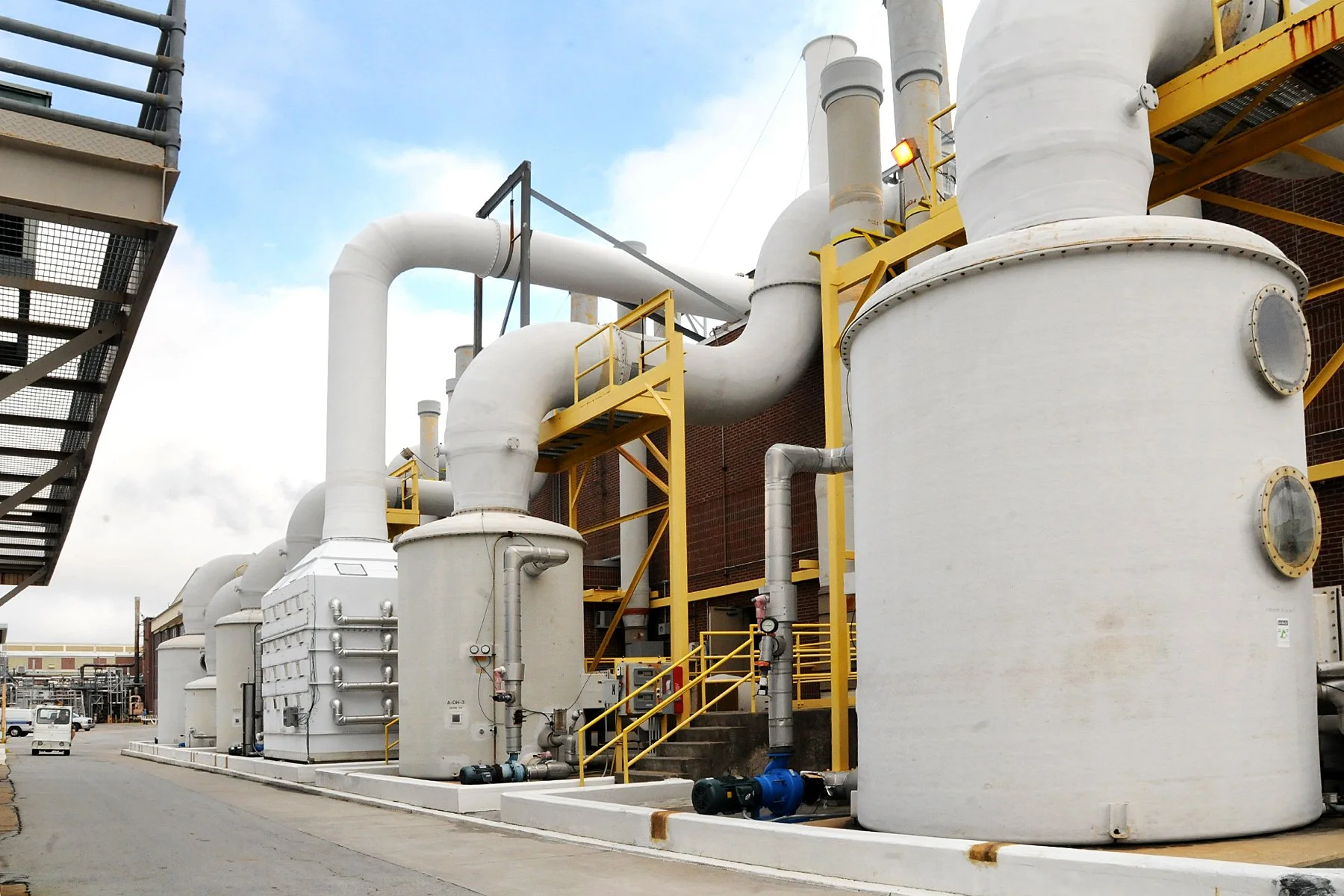
Air pollution control systems, including flue gas desulfurization, selective catalytic reduction, and particulate removal systems, often need to be custom designed to meet the emissions requirements and process conditions of the particular facility of installation. In addition, given the nature of the equipment, performance is also heavily dependent upon the fluid dynamics behavior. Therefore, standard designs need to be simulated according to plant specific process conditions in order to verify that performance meets objectives. If it does not, designs are then adjusted until compliance is achieved.
Using CFD at a SME Manufacturer
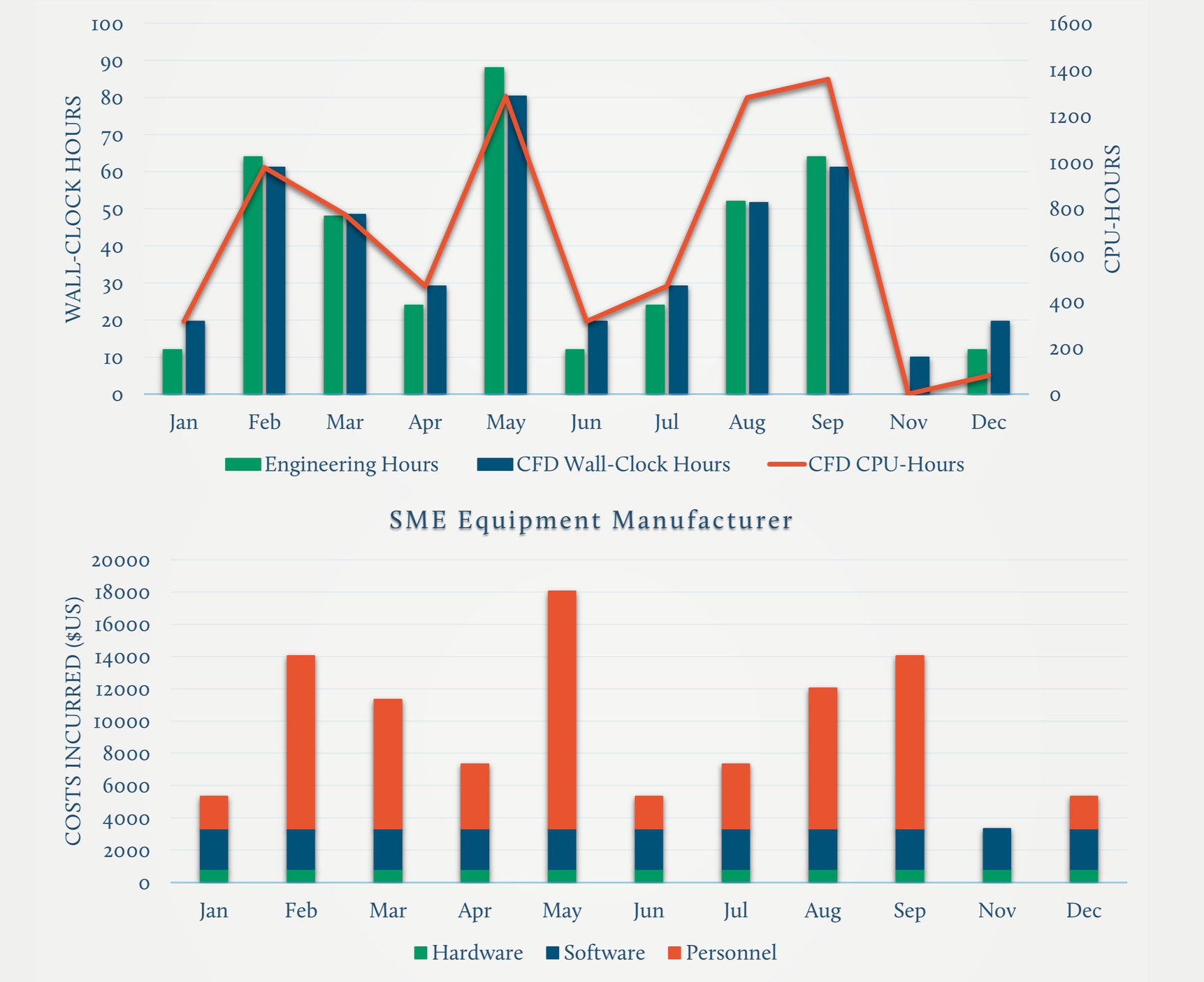
The company has a small team of process engineers that support proposals and project execution in this regards. Proposals typically require 1 or 2 simulations to verify baseline performance and projects can require ~10 additional simulations in order to optimize performance before going into detailed engineering. Each simulation, capturing relatively modest physics such as multi-phase or chemically reacting flows, runs to steady-state convergence and require ~200 CPU-hours on a 5M cell computational grid. The company turns over 20 proposals and 4 projects per year. Engineering time required is on average 6 to 8 hours per simulation.
The SME has a less predictable CFD workload. This company and CFD engineer will be challenged to manage both CFD costs and workforce utilization over the year. With the occasional need for advanced physics such as multi-phase flow and chemically reacting flow simulations, coupled with the part-time CFD use, again the comprehensive CFD packages are the clear choice. A smaller workstation (16 processors, $10,000) and annual license package ($30,000) are allowed due to less demanding schedules and simulations. It should be noted though that this approach will be challenged if multiple projects and proposals are being executed simultaneously as resources will not be adequate and a project overflow plan should be in place, including pay-as-you-go burst licensing. Estimated CFD engineer and computing workloads as well as costs are shown in the following slide.